
Dumb “accomplishment purchases”

Two days ago, I found myself in a hypnotic daze, fumbling around on a domain-buying website.

I was 100% ready to put down $5,899 to buy a 14-year-old domain.

The back story is that a couple years ago, I had an idea for an info business. I even had a great name in mind.

But back then, the .com domain was taken. For that and a few more reasons, my drive to start up that business gradually got weaker… and weaker… and then slipped into a coma.

But then, a few days ago, against all odds, my drive for that business awoke from the coma and jumped out of bed. And the first thing it had me do was see if the domain had become available.

It had!

It was there, ready to be bought, for the low, low price of $5,899, or 24 monthly payments of just $245.79.

I clicked on the “Buy Now” button.

The page asked me to create an account. So I did. I tried to log in.

No soap.

“Click the verification link in the email we just sent you,” it said.

I checked my inbox. Nothing.

I checked it again. Still nothing.

“Fine,” I said, “I’ll do it later tonight.” And I started looking over my notes and plans from two years ago about this business idea.

“Hmm,” I said to myself.

I spent more time reading notes and making plans.

This wasn’t going to be easy, I remembered.

By the time the evening rolled around, my interest in this info business — and that $5,899 domain — had snuck back into bed and fell into a deep sleep.

As of today, it seems to be back in a coma.

I’m sharing this with you as a precautionary tale that might save you some grief.

Because from what I’ve seen in my 6+ years of working as a direct response copywriter… most people in the DR world are by nature opportunity seekers.

That includes me.

And as an opportunity seeker, I often, in a hypnotic daze, mistake spending money with accomplishment.

Like I said, maybe that’s you too. If so, remember my domain-buying story, and the following coma of my drive to build the actual business.

This isn’t just about saving yourself thousands or tens of thousands of dollars… though there’s a good chance that remembering this story can do that.

But more important, it’s about saving your drive and self-respect. Because every failed “accomplishment purchase” saps those virtues a little bit.

The fact is, good opportunities are out there.

But inevitably, it takes some work to make them work. And the fewer dumb “accomplishment purchases” you’ve made before, the easier it will be to do that necessary work.

Anyways, here’s an easy opportunity that costs little money and requires even less work.

I have an email newsletter. It’s free to sign up and even more free to read. In case you want to grab a spot, here’s where to go.
The #1 rule for independent thinking

One day not so long ago, I was taking a short six-hour break to poke around the Internet, when I saw a trending article that made me chuckle. The title read:

“25 Anti-Mimetic Tactics for Living a Counter-Cultural Life”

I chuckled because the term mimetic — how humans imitate each other — exploded in popularity in the second half of last year. The source of the explosion was the book Wanting, which was published last June and soon after became a bestseller. Suddenly, mimetic was everywhere.

And that to me was the funny bit.

Mimetic the term is itself mimetic. And so that article about anti-mimetic strategies is a little like writing,

“An Independent Thinker’s Guide to Independent Thinking for Other Independent Thinkers”

I bring this up because of a fundamental belief I have, which I want to share with you. Maybe it will resonate with you, and maybe it will even be valuable to you in some way. My belief is this:

If an idea is worthwhile, it will still be worthwhile in a year from now.

On the other hand, if an idea seems worthwhile today, there’s a good chance it won’t seem so in a year.

This leads to a simple rule:

Only give your attention to the many ideas that have survived for at least a year. Articles, books, scientific theories, comic strips, cocktail recipes, Saturday Night Live skits, terms and phrases.

And yes. I understand the contradictory nature of sharing this idea with you in a disposable daily email. The only thing I can say is that I’ve never shied away from contradicting myself.

Anyways, Wanting, the book, was published on June 1, 2021. I still haven’t read it — and I won’t, at least until its one-year anniversary. That’s what I recommend to you as well.

But maybe you’re looking for something to read.

Maybe even something that’s been around for more than a year.

In that case, I can further recommend a little book I wrote and published some 18 months ago.

It collects 10 ideas — some of them a few years old, some a few decades, one almost a century — from 10 of history’s most successful and most influential direct marketers and copywriters.

To find out more or to grab a copy:

https://bejakovic.com/10commandments

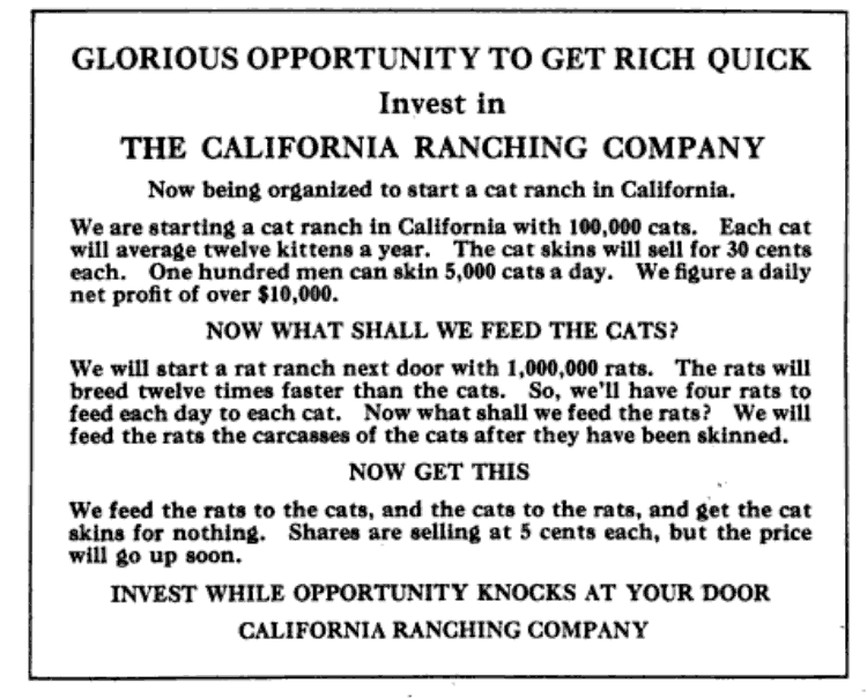
Glorious opportunity to get rich quick

People were pushing each other on the curb and trying to get a glimpse of the window.

“What does it say?”

“It sounds like a real live stock.”

“I’m gonna invest, that’s for sure.”

In 1920, a bank manager named I. Webster Baker posted a giant ad in the window of the Guardian Savings & Trust Co. of Cleveland, Ohio.

The ad was clearly a joke.

It was so outlandish and ridiculous that no sane person could think it was real.

But just to be sure, Baker posted a sign, written in large letters, under his ad. The sign read:

“Some gullible people will try to buy this stock. It is a foolish joke, of course, but no more foolish than many ‘wildcat’ schemes being promoted to-day. Investigate before investing. Don’t hand your money over to any unknown glib-tongued salesman.”

And yet…

Passersby stopped on the street to read the ad.

Some saw the sign below the ad and moved on, chuckling to themselves.

But others took their place. A crowd started to form. A gold rush feeling was crackling in the air.

People started pushing into the bank.

“Say, where can I get more information on that California Ranching stock that’s being advertised in the window?”

“Oh that stock isn’t anything,” said the bank assistant with a twinkle in her eye. “We have other, better stocks you might like to invest in.”

“But I don’t want other stocks! I want that one in the window.”

Such is the power of gullibility, or if you’re feeling less kind, of human greed.

Serious men, business men, doctors, lawyers, stock brokers, all responded to the California Ranching Company ad.

​​They did so both when the ad appeared in the window of the Guardian Savings & Trust Co., and on numerous other occasions, when the ad popped up in small-town newspapers across the U.S.

These men wanted a chance, as one investor said, “to turn an honest nickel into an honest dollar overnight.”

The gruesome nature of the advertised business, and the impossible promise of 100%, non-stop profit, didn’t keep these men from rushing in with cash in hand, and yelling, “HERE, take my money!”

At the Cleveland bank, what they got is disappointment. What they got in the case of the newspaper ads were scams that made their money disappear.

Maybe you’d like to see the original ad.

​​Maybe you’re curious about the business of the California Ranching Company.

​​Or maybe you’d like to study how this ad did its thing, so you can apply some of the same ideas to a less gruesome, more realistic business.

You can find the ad below. But before you read it, make sure you invest in a free subscription to my email newsletter, while opportunity knocks at your door.

How to be seen as a more credible source of solutions and advice

Today, YouTube served me with up a recent interview that PBS did with Garry Kasparov.

Kasparov was World Chess Champion for 20 years and then an opposition leader in Russia.

“Unfortunately,” the interviewer said in his opening move to Kasparov, “you turned out to be right. Back in 2015, you wrote a book called ‘Winter is Coming: Why Vladimir Putin and the Enemies of the Free World Must Be Stopped.'”

The interviewer took a breath after reading out that title. He went on:

“Now that we see what he’s doing, what should our response be?”

Given Kasparov’s book, this might seem like a reasonable question to ask.

And that’s just the point I want to make to you today. There’s something important hiding inside that question.

In the words of Mark Ford and John Forde from Great Leads… the fact that you understand what’s wrong can help make you seem like a more credible source for solutions, too.

The fact is, just because Kasparov wrote a book critical of Putin gives him no special insight on how to stop the raging war in Ukraine. The two are about as related as knowing that “heavy turbulence makes for unpleasant flights” and knowing how to land a jumbo jet.

And yet, it doesn’t matter. The human instinct to jump from one to the other. Because when we’ve got trouble, it’s natural to look outside ourselves for the solution. And at those times, we are willing to accept a lot of things as qualifications and authority.

The takeaway for you is clear:

Don’t build a better mousetrap.

Instead, write a book. Educate your prospect about the dangerous breeding habits and expansionary intent of the eastern harvest mouse. “The eastern harvest mouse is coming,” your book should say. “And it must be stopped.”

Ok, let’s get to the business end of this post:

If you want more advice on building credibility with your audience, you might get value from my email newsletter. That’s where I regularly write about reasons that credibility fails. You can sign up for it here.

Update on that Super Bowl ad

Last week, I wrote about the “best” ad from Super Bowl 2022. If you don’t know what I’m talking about, here’s a bit of recap:

The whole ad was a QR code bouncing around for a minute, like an old-school Windows screensaver.

If you scanned the QR code, it took you to a page to sign up for a Coinbase account.

The ad drew a lot of response. So much so that the landing page crashed.

But in spite of the big response, it’s unlikely that Coinbase recouped the $13 million it cost to run this ad.

So that’s the recap. And now for the update:

A few days ago, Brian Armstrong, CEO of Coinbase, wrote a Twitter thread talking about the making of this ad.

It was mostly about how cool and creative his team is, and how he likes to pat them on the back, and how he also enjoys having his own back patted.

But the thing that really caught my eye was— “and of course the production budget was tiny, less then $100k.”

Hmm. A tiny budget, less than $100k, for a QR code bouncing around on the screen… something you could get done for on Fiverr for $30?

This brought to mind something copywriter Dan Ferrari wrote a few years ago. Dan was writing about big changes in the DR world. This bit has stuck with me ever since:

Because I’m not sure you’re aware, but there’s still a HUGE world outside of the digital players I’ve been talking about so far.

They’re now entering our world as well.

Specifically, I mean big direct response TV spenders and “brand” companies.

Why? Because their channels are drying up. Everything is moving digital.

I recently met with one of the top execs for a HUGE direct response TV company.

They make even the $200M per year financial publishers look small.

Guess what they’re doing?

Moving online. TV doesn’t work nearly as well for them anymore.

So watch as companies with products and businesses that don’t really fall into our little world of internet direct response start to require the services of people that know how traffic, copy, and funnels work online, at mega-scale.

Just to be clear:

I’m not suggesting you try to sell direct marketing to clueless brand businesses. If their idea of good advertising is a glossy page in a magazine, showing a man in a rowboat, in the middle of a lake, with the company logo hiding somewhere in the corner… well, you won’t change their mind.

But like Dan says, we might be in the early days of a giant opportunity.

So if you are enterprising, now might be the time. The time to take standard DM insights… and sell them to a virgin direct advertisers like Coinbase. The production budget? A mere trifle — $100k or $300k or maybe just a mil.

But perhaps you don’t know enough about how traffic, copy, and funnels work online.

In that case, sign up to my email newsletter — because these are all things I write about regularly.

Reddit vs. Hacker News: How to get better customers, clients, readers, and business partners

Paul Graham is a computer programmer, writer, and early-stage tech investor.

His startup fund, Y Combinator, helped start a bunch of famous companies, like Airbnb, Dropbox, DoorDash, Instacart, Zapier, and Reddit.

The total valuation of all Y Combinator companies is now over $400 billion. Y Combinator owns 7% of that, or roughly $30 billion.

Really, the only reason I know this is because I’ve been a regular reader of Hacker News for the past 14+ years.

Hacker News is a news board. Graham started it in 2006 as a way of sharing interesting ideas and getting connected to tech talent. Today, Hacker News gets over five million readers each month.

I’ve been thinking about creating something similar, just with a different focus. So I was curious to read Graham’s 2009 article, What I Learned From Hacker News, about the early experience of creating and running HN.

This bit stood out to me:

But what happened to Reddit won’t inevitably happen to HN. There are several local maxima. There can be places that are free for alls and places that are more thoughtful, just as there are in the real world; and people will behave differently depending on which they’re in, just as they do in the real world.

I’ve observed this in the wild. I’ve seen people cross-posting on Reddit and Hacker News who actually took the trouble to write two versions, a flame for Reddit and a more subdued version for HN.

Maybe this only stood out to me because something I’ve thought and written about before.

Your content, marketing, and offers select a certain type of audience. That much is obvious.

What is less obvious is that your content and marketing and offers also change people. Because none of us is only one type of person all the time.

So if you want an audience that’s smarter, that’s more respectful, that’s more thoughtful and less scatterbrained, then make it clear that’s what you expect. And lead by example.

This can be transformative in your everyday dealings with clients, customers, readers, and prospects. And who knows. It might even become the foundation on which you build a future online community.

If you found this interesting, you might like my email newsletter. You can sign up for it here.

The limits of persuasion and propaganda

“We tend today to exaggerate the effectiveness of persuasion as a means of inculcating opinion and shaping behavior.”

Today I was planning to write a standard email about marketing and persuasion. But I checked the news this morning, and I saw that Russia invaded Ukraine by land, air, and sea.

It’s the biggest attack in Europe by one state against another since World War II.

I’m close to people who have families living in Ukraine, and for them this has real consequences.

So a warning: Today’s email is a persuasion downer.

Because I mostly write about persuasion tricks and manipulation strategies.

There have been plenty of those in the past few weeks from the EU and US both, in anticipation of the Russian invasion. But as a US diplomat put it:

“One of the shortcomings is the deterrence package that we’ve developed is kind of asymmetrical in that it’s mostly economic and we’re facing a military threat.”

Another way to put it is the quote I have up top, which is from Eric Hoffer’s True Believer.

​​Hoffer thinks that the fabulous power often ascribed to words has “no greater foundation in fact than the falls of Jericho ascribed to the blast of Joshua’s trumpets.”

So if not words, then what?
​​
Well, here’s a last Hoffer quote to wrap this emergency email up. It might be worth keeping in mind as we enter a new age of political black swans:

“The truth seems to be that propaganda on its own cannot force its way into unwilling minds; neither can it inculcate something wholly new; nor can it keep people persuaded once they have ceased to believe. So acknowledged a master of propaganda as Dr. Goebbels admits in an unguarded moment that ‘A sharp sword must always stand behind propaganda if it is to be really effective.'”

A watermelon-headed politician walks into a flat-earther’s house…

I’d like to tell you a story but first I have to give you a bit of background. Our story has two characters:

First, there’s Pericles, a famous statesman in ancient Athens.

Pericles led the Athenians at the start of their war against the Spartans. He was also well-known for having a watermelon-sized head. That’s why statues most often show him wearing a helmet.

Second, we have Anaxagoras, a philosopher who came from Asia and settled in Athens.

Anaxagoras brought with him the spirit of scientific inquiry, which wasn’t common in Athens before. He also happened to be a flat-earther.

Now, on to the story:

When Pericles the Athenian was a young man, he studied philosophy with Anaxagoras.

Later, Pericles became a powerful man. When he needed to make important political decisions, he still consulted his wise old teacher.

But as Pericles sailed the seas, leading the Greeks in battle, Anaxagoras grew older and poorer. There aren’t many drachmas to be made in explaining rainbows or what the moon is made of.

In time, Anaxagoras became so poor he could no longer afford even a bit of cheese and wine. So one day, he did the only philosophical thing:

He covered his head with a robe, and determined to starve himself to death.

When Pericles heard about this, he rushed to Anaxagoras’s house.

He started begging his old teacher to live. He lamented his own hopeless future if he should lose so valuable an advisor.

There was a moment of awkward silence.

Then Anaxagoras yanked the robe off his head, looked at Pericles, and said, “Pericles, those who want to use a lamp supply it with oil.”

So that’s the story.

I don’t know about you, but when I first read it, it made me laugh.

And because I like to kill a good joke, I asked myself why I found this story funny.

Was it the idea of an old man starving himself to death?

Not really funny.

Was it the lamp analogy at the end?

Not so funny either.

I realized it was the robe.

​​Anaxagoras put it on his head and then pulled it off. It made him seem like a petulant child. It was such a contrast to the image of a sage and self-possessed philosopher.

So there you go:

Seemingly irrelevant details give all the color to a story. They can create suspense. Enjoyment. Or, of course, humor.

But perhaps I didn’t kill enough jokes for you today.

If so, then subscribe to my email newsletter, so I can kill another joke for you tomorrow.

And then, then take a listen to the 2 minute and 45 second clip below. It’s a recording of a young Woody Allen, delivering a standup routine in the 1960s.

Then listen to it again. And notice all the detail — seemingly irrelevant, but really, just what makes the skit funny. it might be something you can use in your own writing.

​​Here’s the video:

Skunk email with a great and valuable reward

This email won’t be easy or pleasant to get through.

​​In fact it will take work and it might make you feel queasy along the way. But if you can manage it to the end, the rewards will be great.

Let me start by telling you I’m re-reading Claude Hopkins’s My Life in Advertising. And one story I missed before is this bit from Hopkins’s childhood:

One of the products which father advertised was Vinegar Bitters. I afterward learned its history.

A vinegar-maker spoiled a batch through some queer fermentation. Thus he produced a product weird in its offensiveness.

The people of those days believed that medicine must be horrible to be effective.

We had oils and ointments “for man or beast” which would make either wild. We used “snake oil” and “skunk oil,” presumably because of their names.

Unless the cure was worse than the disease, no one would respect it.

Today we assume that every offer must be fast, easy, and cheap.

But human nature changes like glass flows — so slowly that we will never see it happen.

And a part of the human brain still believes, like it did in Hopkins’s day, that the cure must be worse than the disease. At least along some dimension.

So if your offer is fast and easy, make sure it’s not cheap.

Or if your offer really is all of fast, easy, and cheap… then at least throw a skunk or a snake into it somewhere.

In other words, turn your prospect into a hero. Tell him a story:

He’s somebody who’s willing to do what’s offensive to others… somebody who can swallow what would turn most men or beasts wild. ​​No, it won’t be easy or pleasant. But if he can manage it to the end, the rewards will be great.

Last thing:

Maybe you’d like to know I have an email newsletter. It’s cheap and easy, but it’s very slow. You can sign up for it here.

The blood-drive bobblehead bonus

A friend of mine once gave blood because the Red Cross was giving away bobbleheads.

If you’re not American, you might not know what a bobblehead is—

A little figurine, plastic or ceramic, with an oversized head on a spring. Tap the head and it starts bobbling around, hence — bobblehead.

My friend normally never gives blood. And his experience giving blood this time was particularly slow, painful, and scary.

In the rush and push of the big blood drive, the nurses forgot about him. He looked on in panic for what seemed like a long winter, convinced that air bubbles were coming up into his veins.

And yet, he did it, for the bobblehead, because he’s a big baseball fan.

My friend staggered out afterwards, clutching his bobblehead of Brooks Robinson, the legendary third baseman for the Baltimore Orioles.

“Please take me home,” he said weakly.

So I gave him a ride back to his place, where he spent the next three days sleeping and recovering, with the Brooks Robinson bobblehead next to his pillow.

My point being, you can sell a lot of unsellable stuff by giving away a free gift.

​​But you probably knew that already.

So let me zoom in a little and point out that you can sell a lot of unsellable stuff by giving away a completely unrelated free gift.

Most bonuses in the DM world tend to be relevant to the main offer:

“Order a ThighMaster NOW and get FREE a ButtMaster plus a copy of Suzanne Somers Toning System™ workout video!”

But a free bonus doesn’t have to be related to your core offer. And in fact, it might work better if it isn’t.

The blood-drive bobblehead is just one example.

I also remember hearing Dan Kennedy give a couple of other examples.

The magazine Advertising Age, which sold subscriptions with a bonus mug. No relevant bonus could outpull the mug.

And Omaha Steaks, which sold steaks, from Omaha. Their best-performing free bonus was a calculator.

Why?

​​Who knows. Just know this:

If your current offer is as much fun as giving blood… then your free bonus doesn’t have to be a kidney removal.

And now, please sign up for my email newsletter. If you do, I’ll send you a free bonus, a picture of the cover of Breakthrough Advertising, with Gene Schwartz’s name blocked out and your name pasted in.