The case against steak upsells

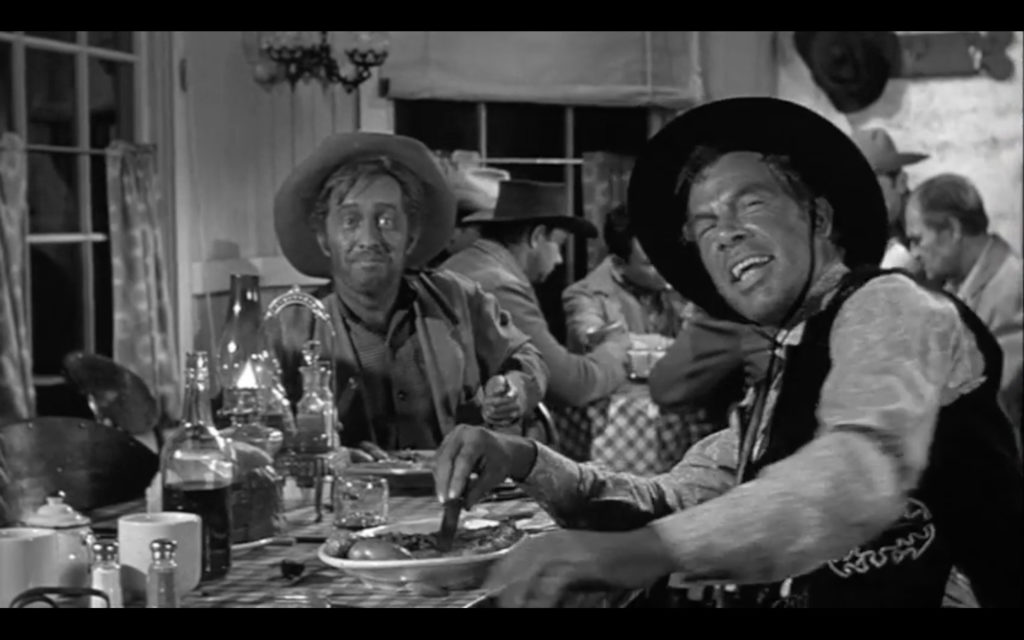
“Hell yeah we’ll take five more steaks if you cut the price”

Imagine going into a restaurant. You’re hungry and you’re raring for a steak. So you look over the menu, find your steak, wince a bit at the price, but decide to get it.

“I’ll have the 12-ounce steak,” you say to the waiter. He writes this down patiently in his notebook and then says,

“Would you like 18 more ounces of our fine steak at 50% off? You can always take it home with you if you don’t finish.”

Because you’re hungry and it’s a tempting deal, you order the extra slab of meat at a discount. But of course, when it arrives, you can’t finish it. You take it home, where it becomes more of a responsibility than a joy, sitting there cold and hard in your fridge. A few days later you toss it out.

Next time, you stay away from that restaurant. Somehow, you have a bad feeling. You spent too much money. You were emasculated by not finishing the steak. And you don’t need the temptation a second time.

I’ve recently heard a couple of contrasting positions on upsells. Just yesterday, I listened to an interview with successful copywriter and marketer Justin Goff. He talked about how the best upsells are often more of the same.

“Buying one bottle of supplements? How about 3 more at a discount?”

At the same time, Justin talked about the incessant need most direct response businesses have for new customers. According to Justin, new customers are the ones who buy the product, and even the ones who take up affiliate offers. That’s position one.

Then there’s Sean D’Souza. Along with a copy of his Dartboard Pricing book, I got a copy of a talk Sean did for the Ken McCarthy’s System Club. This talk is on the topic of consumption. And one of the things Sean says explicitly is that you don’t want to overwhelm your customers with product, even if they are willing to buy it.

Sean also talks about treating customers the way you would treat your kids — that is, looking out for them and charting a path for them down the line.

Perhaps not surprisingly, Sean’s business seems to rely on a much smaller number of customers, who happily keep coming back year after year and forking over thousands of dollars for Sean’s courses and trainings. It’s what Sean calls a focus on consumption over conversion. That’s position two.

So what’s the conclusion? I guess it depends on what kind of business you’re looking to run. If you want to scale quickly and max out revenue, then aggressive “steak” upsells make sense. If you want to have a long-term business, another strategy might be better.

For example, even in Sean’s way of running a business, the right kinds of upsells can have a place.

Imagine if in that restaurant, the waiter did something different. Imagine if instead of upselling you on more steak, he recommended a special beer on tap, and his favorite salad off the menu. This would still be an upsell, though it wouldn’t make as much money as selling more steak.

Your consumption experience would be much better. You’d be more likely to return. And the restaurant wouldn’t have to constantly worry about digging up new customers.

A bizarre example of disconnected infotainment

Photographer Leopold Kanzler worked with this beaver for two weeks hiding apple slices in his camera to get this shot. “I’m not sure who had more fun, me or the beaver, but it seemed more than happy with receiving so many tasty treats.”

I just finished reading the Dartboard Pricing book from Sean D’Souza. It’s the first of his paid products that I’ve read. And there were many things from this book, besides the content, that I thought were worth adopting.

Once upon a time I read an article of Sean’s on the topic of infotainment. He had various bits of advice, and one of them was something like:  “You can connect or disconnect the entertaining part to the information part at will.”

In other words, if you are writing an email or a blog post or a book, it’s important that the email or blog post or book is fun to read. It’s also important that it has valuable content. The entertainment and the content can be connected, but they don’t always have to be.

In Sean’s Pricing book, he has lots of what you could call infotainment. Cartoons. Stories. And then, there’s a recipe for chicken biryani, spread over 3 pages.

The cartoons and stories tie into the content of the book. The chicken biryani does not, at least as far as I can see.

To sum up, connect or disconnect the infotainment at will. But my gut feeling is — there’s value in occasionally disconnected infotainment — it keeps people surprised and gives a sense of wonder.

I don’t think it’s something to do all the time. But once in a while, it’s better to throw in something fun and bizarre, rather than fun but reasonable.

7 types of infotainment to stuff into your information product

Right now, I am writing a book that I will sell through my essential oils site.

I know the subject matter very well, and I could drone on about it even if somebody slapped me awake in the dead of night.

But it’s boring to just hear lots of facts and warnings and instructions, and I worry that my book will turn out dull. Since I want people to actually read this book and to get something out of it, I have to make it fun as well as informative.

Enter infotainment: entertainment combined with information. It’s something I first heard about from email marketing headmaster Ben Settle. So for your benefit as well as mine, here are 7 different types of infotainment you can stuff to make your dry-as-dust information product more exciting:

1. Cartoons

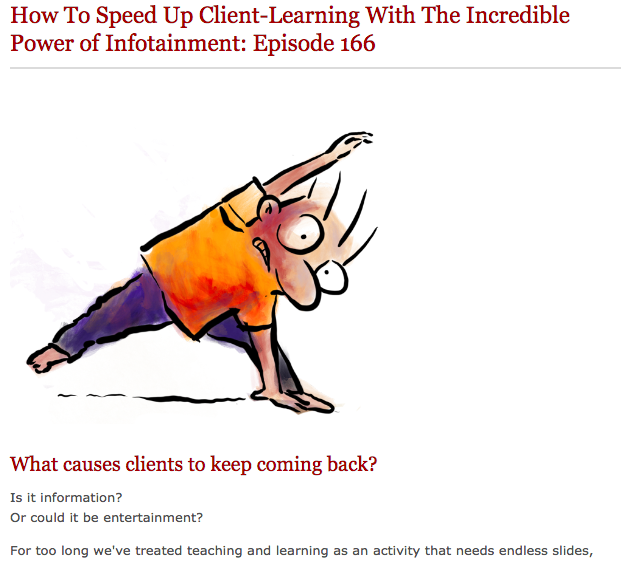
Cartoons. Every few pages. They can be used to add some color, to lighten the mood, and to reinforce a point.

New Zealand marketing guru Sean D’Souza is a master of this. Here’s an example from one of Sean’s articles on infotainment:

2. Vignettes

The New Yroker magazine does this.

Vignettes are like cartoons, but they are smaller, spread over multiple pages, and not directly connected to the surrounding text. Here’s a couple of examples from the Aug. 22, 2016 issue:

3. Stories

Stories stick. They make otherwise boring content interesting. Plus they are fun to read.

I kick off my essential oils book by telling the true story of a 2-year-old boy who got burned in a fire, how his mom used essential oils to help his wounds heal more quickly, and how the surgeons marveled and approved from the sidelines. It’s a great story, and it illustrates the power of essential oils way better than arguing with statistics or hand-waving about anti-inflammatory molecules.

4. Fun break

If you read some of the sales letters by Gary “greatest living copywriter” Bencivenga, you will frequently come across sidebars.

Just like in a magazine, these sidebars serve as a fun break, a chance to talk about something interesting, and to draw attention to it.

For example, in the book I’m writing, while talking about different proven health benefits of lavender essential oil, I have a sidebar that talks about four entirely different locations around the world where lavender is grown.

And I include some local color. One of the places has a mysterious monument that a crusader supposedly set up. Another is a kind of Shangri-La, with perfect weather on an otherwise rainy and cold mountain. A third served as a prison for the last monarch of the Austro-Hungarian empire.

5. Images

Like cartoons. Images are best when they are both relevant and surprising, beautiful and informative. Kind of like the vignettes I included above.

6. Word fun

This is an area where Ben Settle shines. His emails are fun to read, and one of the big reasons why is all the creative and colorful and unexpected language he uses.

Plus they sound super-conversational. In fact, they are more conversational than real conversation.

Poet Anthony Madrid, who writes for the Paris Review, is also a past master at this. Here’s an example:

We take the phrase “once upon a time” for granted, but if you think about it, it’s quite oddball English. Upon a time—? That’s just a strange construction. It would be pleasant to know its history: When, more or less, does it get up on its legs? Around when does it become standard procedure? My researches into this question, however, have yielded nothing conclusive.

7. Analogies

Analogies are like stories: they make boring or preachy content palatable.

A few weeks back, I was working on a probiotics sales page, and I compared probiotics you can buy at the store to mystery meat in a rusty can. For the essential oils book, I’m planning on doing something similar, I just haven’t figured out yet what dangerous-but-familiar image to compare mommy blogs to.

So there you go. 7 ways to infotain. They are formulaic. They are mercenary. And they workses.