A new way to approach copywriting

I recently started keeping track of every article I click on mindlessly, purely because of an intriguing headline. Here are a few:

* After Years Of Conflict And Instability, Iraq Is Opening Up To Tourism

* A Writing Tip I Learned At Oxford

* A New Way To Approach Wayback Machine

* The New Credible Science Of Longevity Versus The Old Anti-Aging Snake Oil

* Nikola Tesla Invention From 100 Years Ago Suddenly Makes More Sense Today

So I record those headlines, and then I ask myself, Why? Why did I click on this?

If you’re in the business of marketing, I’d like to suggest this new habit to you too.

But why?

Because, as Gary Halbert said, you have to steep yourself in what’s working now. If you’re clicking it, others are clicking it. Pay attention, and you’ll find out what’s working now, both in terms of format (“A New Way To Approach X”) as well as in terms of topics (“Wayback Machine”).

But Gary also said something else. He said you have to ground yourself in the fundamentals of marketing.

That’s why asking why is useful.

Human psychology changes very slowly, if at all, from what I can see. And if you ask yourself why, you’ll get back to a few fundamental answers, over and over and over. And then you can make your own formats, for your own topics, and still have people clicking and reading.

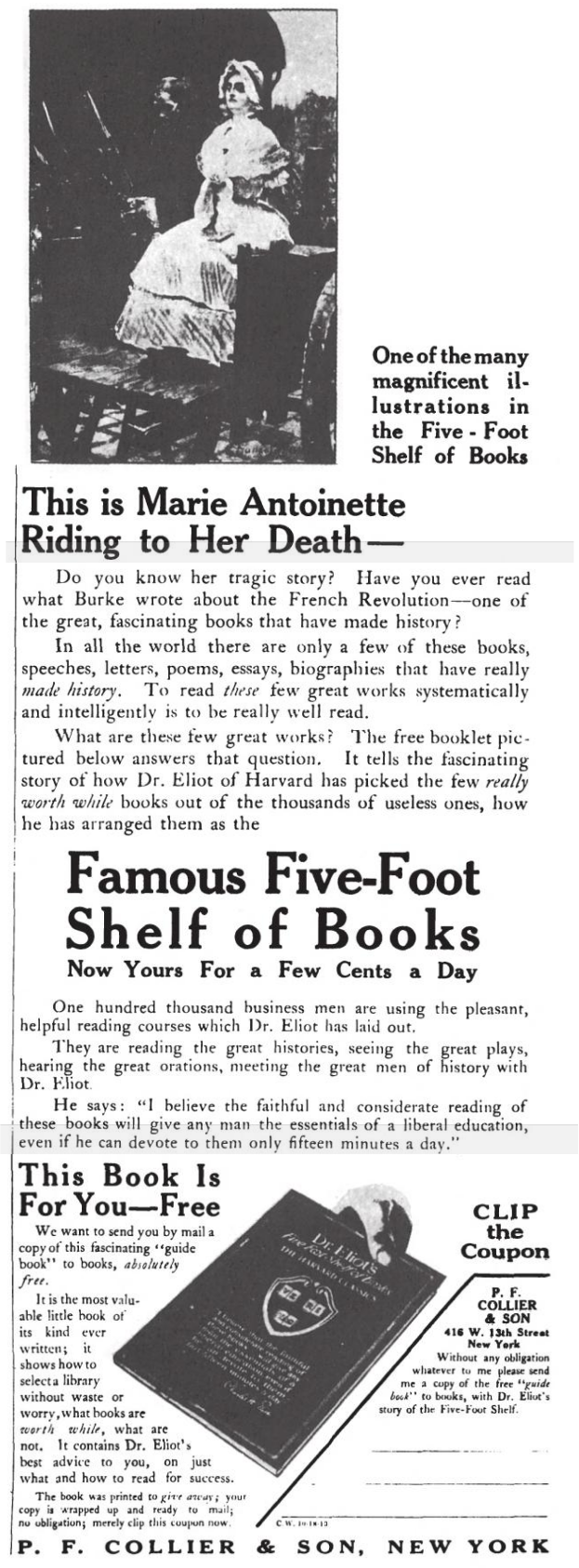
By the way, human psychology changes so slowly that there are some ads that ran a hundred years ago, which could still run successfully today.

If you want to see an example, I’ll share one tomorrow in my email newsletter. And if you want to get on that newsletter so you get to see that ad, here’s where to go.

My Airbnb pre-suasion ticket

I moved into a new Airbnb a few days ago. The host met me there to let me in. Fine. But then he wouldn’t leave.

He pointed out where the bedroom is. He showed me where he keeps the ironing board. He mimed how to press the button that turns on the hot water heater.

And then he walked to the front door and said apologetically, “Well… I guess there’s nothing else…”

But there was. Three more times he started to leave… and three more times he went off on another tour of the apartment.

He highlighted the lacquered kitchen counter.

He explained the quirks of the TV to me, even though I told him I don’t watch TV.

And when he was finally leaving for real, he said:

“People tell me there’s something about this apartment. A good vibe. I don’t really get it. But a few people who stayed here made me an offer to buy it outright. They say it just makes them feel good to be here.”

I told him I’d keep my antenna out for the special vibe.

And the craziest thing happened.

I think the guy was right.

I’m not sure what it is. Maybe it’s the quirky mix of decor. Maybe it’s the shady maple trees in front that reach right up to the windows. Maybe it’s because I’m sleeping like a bear in the cool and dark bedroom.

Anyways, I probably would have let all this slip into oblivion. Except I’ve been reading Robert Cialdini’s Pre-suasion over the past few days.

And that book got me thinking. Because the first few chapters are all about the power of attention.

Draw somebody’s attention to a fact, says Cialdini, and that fact gains in importance. (“Good vibe, huh? Well, we’ll see.”)

Not only does a highlighted fact gain in importance, but other facts lose in importance. (It took me days to notice the apartment is very dark. Must be the maple trees.)

And there’s more:

Attention can create causality. Even where there is none. (“The kitchen counter really is nice. Could that be why I like this place?”)

Well… I guess there’s nothing else I want to tell you today.

​​(1… 2… 3…)

​​Except let me just add one last thing:

You probably already knew how important it is to manage the attention of people you want to persuade.

You probably even knew that you want to draw attention to things that help your case… and to keep attention away from things that hurt your case.

Whatever. I thought it was still worth pointing all this out to you.

Because now that the power of attention has been pointed out, maybe you will start to see its importance in a way you hadn’t seen before.

​​Maybe you will see how it’s being used on you to guide your own decision making.

​​​​And when that happens, maybe you will become more effective at persuading others… with a creative light show, which highlights just what you want, at just the right moment.

I guess there’s really nothing else. Except just one more thing:

I write an email newsletter. I’ve had a few people who subscribe to it say it’s surprisingly fun and valuable. I don’t really get it. But if you want to try it out, here’s where to sign up.

I wanted your advice

Today I was planning on writing about an undercover method to persuade people, or to actually let them persuade themselves.

This method is sweet because it does double duty. It gives people good reasons to believe what you want them to believe… while at the same time sweeping under the rug any reasons they might have to object.

But then something unexpected jumped out at me in real life, like a tiger out of the dark. And so I won’t have the chance to give this topic its proper treatment today.

Instead, I sent out a very special email to my newsletter subscribers, asking for help and advice. Unfortunately, since you’re not on my newsletter, you didn’t get that email.

If you’d like to join my newsletter, you can sign up here. An extra reason to do so is that tomorrow, I’ll write and send out an email with that promised marketing lesson, which I didn’t get to today.

Prophet positioning

“Let me explain something to you right now,” the goofy looking guy said to the camera. “Here’s a $10 bill.”

And he started to tear the bill up into small pieces in front of the interviewer’s face.

“This is garbage. This is going to zero. Euros are going to zero. The yen’s going to zero. All going to zero… against bitcoin!”

The Bitcoin prophet got louder and his voice started to crack.

“If you don’t understand this, you’re going to be impoverished! You’re going to be out on the street! You’re gonna be begging! You’re gonna be out of business!”

That’s from a little clip I saw today. It went viral so even somebody like me, who doesn’t follow crypto news, got to see it.

The question is why.

It might be because the Bitcoin prophet looked like a kook. He was dressed like Elton John. Even the interviewer was giggling at him. Maybe people who shared the video just wanted to make fun.

But I’ve got my own theory.

Which is that making strong predictions, saying X is dead, Y is the future, is a great way to grab attention and carve out a position for yourself in the mass mind.

Now the clip I saw had a tongue-in-cheek element to it. It seemed even the Bitcoin prophet was about to crack a smile as his performance built up.

But if you don’t hedge your bets like that…

If instead you have the conviction (or connivance) to paint the future black and white… and you do it in a way where people can believe you really mean it…

Then that’s the road to being seen as an authority. A leader. A prophet.

And that’s something all of us crave.

Because few things are scarier and more motivating than the uncertainty and lack of control that come from looking at the frosted glass window that is the future.

Which is why it doesn’t matter if your predictions are right or wrong. People will follow you, or at least some will. Even if you’re wrong. And even if the rest of the world thinks you look like a goof or a kook.

But perhaps pretending to be a prophet doesn’t suit you. Maye you think that’s garbage.

What’s not garbage is your need for positioning in the market. If you don’t understand this, you’re gonna be out of business, begging, out on the streets.

I write about positioning on occasion. I have many ideas about it. If you want to read about them as I write about them, sign up to my email newsletter.

Entrepreneurship: A loser’s game

A couple nights ago, I stayed up two hours past my bedtime to watch TV and witness a miracle.

Well, a sports miracle:

Novak Djokovic beating Rafael Nadal at the French Open.

In case those names mean nothing to you, I’m talking tennis. And what Djokovic did is the hardest thing in that sport.

After all, Rafael Nadal has won the French Open 13 out of the past 15 years.

The only times he lost, it was in the early rounds, because he was crippled, hobbled, or hamstrung. Whenever he made it to the end stages, like this year, he was unbeatable. Until this past Friday.

It took an incredible effort. In fact, both Djokovic and Nadal played at the highest levels.

They made tennis look like ping pong, because of how they moved each other around, with crazy angled shots, delivered from far off the court and from seemingly impossible positions.

Other pros and commentators gushed afterwards that it was one of the greatest matches in history, and probably the greatest clay court match ever. Nadal and Djokovic are from another world, they said.

Well. Contrast that to my real-life experiences with tennis.

I started playing when I was a kid. If you saw me play, you might think I have skills. But I don’t.

In fact, I have such an extreme lack of skills that two years ago I vowed never to play again. It was just too painful.

I’d play a match against somebody who I should be able to easily beat. And I’d still end up losing.

Double faults… routine balls dumped into the net… attempts at winners that sailed a foot wide.

Each mistake-filled loss would set off a binge of self-hate that lasted for days, until it was time to play (and usually lose) the next match. So I decided to give it up.

And that’s my point for you for today.

It turns out that the sport played on tennis courts is actually two entirely different games.

That’s according to a Dr. Simon Ramo, who analyzed the data. Ramo’s research can be summed up simply:

Professional tennis players win points. The rest of us lose points.

In the pro game, outcomes are determined by the actions of the winner, like in the Djokovic-Nadal match.

In the non-pro game, the amateur rarely beats his opponent. But he beats himself all the time.

It’s two opposite games. And Ramo’s data bear it out. Pros win 80% of points. Amateurs lose 80% of points.

Of course, tennis is not the only loser’s game.

So is campaigning for political office… warfare… and modern dating.

In all these fields, outcomes are determined more by our own mistakes and self-sabotage, rather than anything the other side did.

And from what I’ve seen, entrepreneurship fits into this mold too.

We look to the highest performers, like Steve Jobs and Elon Musk. We see how they run laps around the competition and create daring offers that wow customers.

But that’s not the game the rest of us play.

For the rest of us, competition is largely irrelevant and potential customers usually never even see our offers.

Instead, the outcomes we get (typically not good) are really the result of our own mistakes and self-sabotage.

If that’s the case, then what’s the fix?

I don’t have a good answer for you. But I can leave you with the advice that Simon Ramo gave to tennis players:

Lose less. Avoid trying too hard. And keep the ball in play.

But let me take my own advice:

I have an email newsletter. I write an email about persuasion, marketing, copywriting, and occasionally business, every day. Keep the ball in play. In case you want to sign up, click here and fill out the form.

The hidden religion of persuasion

“Well… I need to tell you all something. And it’s the most important thing I could ever say to you. In a little while, you’ll know for certain that I’m putting my very life on the line, and the safety of my family, by sharing this with you. So I hope that buys me at least a few minutes of your precious time.”

So starts out the video by one Altiyan Childs.

Childs was the 2010 winner of Australian X Factor. He came back to relevance last month because he released a YouTube video, lasting five (5) hours, which was shot in what looks to be his bedroom.

In the video, Childs exposes the hidden religion that all stars, celebrities, and people in power belong to, and are bound by an oath never to reveal.

How does Childs know?

Because he himself belonged. But he is now publicly renouncing this evil religion (he found another religion, Christianity, following a near-death car crash) and warning the rest of the world of the danger we’re all in.

The video got about a million views on YouTube in the first few weeks while it was still up.

That’s actually not a crazy number. I saw a similar video, with a similar expose, featuring a similar level of celebrity, pop up last year and get almost 20 million views in a few months’ time.

And I guess even this 20 million is peanuts to the overall popularity of the belief that some kind of evil cabal controls world affairs.

I think there are many marketing and persuasion lessons that can be sucked out of that need and out of Altiyan Childs’s video. Today I just want to focus on one.

Because what really underlies the popularity of such beliefs? Here’s my own secret revelation:

Such beliefs put our messy lives into an order-creating context.

Take a bunch of seemingly random and unconnected facts… draw surprising connections between them… and then place them inside of a bigger frame that gives the whole picture a simple and clear meaning…

… and this creates the feeling of insight.

And this feeling, as I’ve written before, might just be the most powerful and secret persuasion tool that the powers that be don’t want you to know about.

My point is that if you take those three steps outlined above, you can sell not only Christianity… but you can also sell supplements, coaching programs, and financial newsletters.

That’s a big claim.

And I can’t blame you if you’re still skeptical.

All I can say is, I’m putting my very life on the line to dig in further to bring you the full facts on this.

Once the facts are revealed, you will be able to see the truth and make up your own mind.

In the meantime, I hope this buys me a few email opens of your precious attention. You can sign up for my newsletter here. Because I will be back with this topic soon, assuming that the powers that be don’t get to me first.

GROHMO trumps FOMO?

Painful personal confession:

I went to high school right up the street from the offices of various Agora companies.

Unfortunately, this was long ago, at a time when I had never heard of copywriting. So when school would get out, I’d spend my afternoons identifying local trees and kicking cans around the abandoned cement factory.

Had I been smarter, I would have gotten a job cleaning ashtrays at Agora HQ. And bit by bit, I probably would have learned enough about copywriting to be a multimillionaire today.

I bring this up because I recently applied for a copywriting job. Not a freelance project. A proper job.

I tell myself there are lots of good reasons why I applied.

My reasons are all the stuff you can put in a cover letter:

​​I could learn a lot. It could be a step forward in my career. I like the people I might be working with.

In other words, it’s a great opportunity. And I don’t wanna miss out. Except…

Would any of this really count had I not missed out already, in a much bigger way, back in high school?

I recently heard Dan Kennedy talk about writing for the opportunity market. You know, business opportunities and get rich quick stuff. Like copywriting.

And Dan said something that matches my experience above:

Lots of times, the real motivator is not the opportunity in front of us now, which we don’t want to miss.

Rather, it’s the opportunities dead and gone, which we have missed already.

The guilt and regret over having missed out yesterday (GROHMO) is really the underlying cause that makes us susceptible to FOMO today.

And if you’re a smart marketer or copywriter, you can exploit this. You can put up a bunch of pictures of smiling and satisfied men and women and say,

“Look at them. That could’ve been you. These men and women acted when you didn’t. And look at them now. Look at how happy they are. And as for you… well… don’t feel too bad. Because I have some good news. A new opportunity just opened up…”

And it’s true:

I’ve been promoting my email newsletter for a long while. Over time, I’ve had many people sign up. They have been amused and sometimes moved along the way.

More importantly, they’ve learned a lot and they’ve been exposed to copywriting and marketing ideas, like the one above.

These ideas I share have helped my subscribers make more money, enjoy their businesses more, all while working much less.

In other words, my email newsletter is quite the opportunity. Not to be missed out on. Especially since it’s not clear how long it will go for, in case I get a proper job.

In case you want to join before the opportunity disappears, here’s where to go.

Mating and marketing pandemonium

In case you ever wondered how African elephants mate:

A female elephant runs around the savanna while a bunch of horny male elephants chase her.

As she’s getting chased, the female emits a noise known as an estrous roar. This roar is meant to get the attention and interest of even more males, who join in the chase.

Eventually, one of the males, if he can get out of the way of his own enormous erection which is hindering his jogging, manages to catch up to the female and slows her down by putting his trunk on her back.

If all goes well, the female stops.

The male elephant then mounts the female and after an immensely satisfying three to four seconds, the act is over. And that’s when all the elephants, male and female, who were alerted by the roaring and the chasing and the sexing, enter a state known as:

Mating pandemonium.

This is the elephant equivalent of all your friends and family bursting into your bedroom immediately after climax and shouting, “Oh my god, I can’t believe you just had sex! That’s great!”

Except elephants do it by making loud pandemonium roars and pandemonium trumpets, flapping their ears rapidly, and maybe urinating or defecating in excitement.

If you’re wondering how I know so much about elephant mating behavior, the answer is I’ve spent the morning on the Elephant Ethogram site.

This is an online video collection of 404 individual elephant behaviors (rapid ear flapping, estrous roar), 109 constellations of behaviors (mating pandemonium) and 23 contexts in which those behaviors are triggered (attraction and mating).

It seems to me that studying elephants in the wild is fun work and needs no further justification. But the elephant scientists who created this site make the following justification anyways:

“African savanna elephants are among the most socially complex non-human species on our planet.”

And that’s my point for you today.

Elephants exhibit hundreds of behaviors, triggered by dozens of complex social contexts. Humans are the same. Probably more so.

As people who want to influence those behaviors, we often try to reduce it all to a single universal principle, such as “acts in self interest” or “makes decisions based on emotions.”

The fact is, there is no central principle, at least as far as I can see.

Instead our lives are a mishmash of different behaviors, which get triggered in different contexts.

Sometimes we’re trying to impress others. Sometimes we’re trying to run away from pain. Sometimes we’re just moving along with the herd, so we don’t have to spend any energy thinking or deciding. Sometimes we’re measured and logical. Sometimes overwhelming greed kicks in.

On and on and on. Hundreds of individual demons all living in each of our heads.

And if you want to eventually produce the simple behavior of a button click followed by a credit card whip-out…

Then you have to catalogue all of those demons… create checklists of the contexts in which they appear… and then practice and test how to summon them, because sometimes the demons are sleeping, and other times they interfere with each other.

One thing is for sure:

If you don’t do this, you’re gonna miss out on a lot of sales.

​​But if you do it, and you’re successful, then marketing pandemonium erupts. Roaring, trumpeting, cash register ringing. Possibly followed by urinating or defecating in excitement.

And then when the noise settles:

If you want more advice on making the cash register ring, you might like the Human Ethogram available inside my daily email newsletter. Available here, for free.

What never to say when somebody’s angry, upset, or riled up at you

In a small town bar, a drunk farmer pushed his way through the crowd and got in the face of a meek and proper-looking man.

“You sent that tornado that leveled my house,” the farmer roared as he grabbed the meek guy by the lapels. “Now you’re gonna pay for that!”

A flash of panic spread across the other guy’s face. He threw a glance to the door. No bouncer to help.

So in another flash, this meek man changed his panicked face into a convincing scowl. And he grabbed the farmer by the lapels in turn.

“Yeah, that’s right about the tornado!” yelled the previously meek man. “And I’ll tell you something else! I’ll send another one if you don’t back off!”

Which the farmer did. “Hey buddy… take it easy! I was just kidding…”

You might know this true-life anecdote because Robert Cialdini used it in his book Influence.

The meek guy at the bar was a local TV station weatherman. Cialdini used the story to illustrate the power of association, which hounds weathermen with threats, insults, and occasional beatings whenever the weather they announce turns bad.

Yeah, that’s right about association. And I’ll tell you something else:

This same anecdote is also a great illustration of another social phenomenon, the power of agree-and-amplify.

In many situations, when somebody’s angry, upset, or riled up, the worst thing you can do is to try to calm him. Instead, it often works much better to agree with what he’s saying, and to push him further into the negative.

It’s like pushing the rug out from under him. Yes, pushing. Because instead of having a firm piece of ground to stand and fight on, your adversary finds he’s moving away from you. And so his natural instinct becomes to give up his spot, and to take a few steps back towards you.

Which might be interesting if you’re meek by nature and you ever find people attacking you, expecting you to buckle.

But what about copywriting?

Would you ever want to use agree-and-amplify in your copy?

I would say no, not as I just described it above. But this agree-and-amplify stuff connects in my mind to a copywriting and marketing topic I wrote about recently. This other tactic allows you to take something negative, and use it in your favor, even in your copy. In case you’re curious:

https://bejakovic.com/a-transparent-but-effective-marketing-ploy-thanks-jay-abraham

Green Valley must fire its warehouse manager

Last week, supplement company Green Valley, which was founded by A-list copywriter Lee Euler, sent out a panicked email that started with:

Dear John,

We discovered somewhat of a sticky situation last week…

So I’m hoping maybe we can help each other out…

You see, late last week our warehouse manager called to let me know that we have NO room for a large shipment that’s already on its way to our fulfillment facility here in Virginia…

That means I now have to get rid of a few pallets worth of one of our top sellers…

So, I’m knocking 70% off Gluco-Secure—a natural breakthrough shown to…

I don’t know who’s at fault here. But I find the warehouse manager’s “not my circus, not my monkeys” attitude contemptible. ​​Particularly since he allowed a similar situation to happen last September. That’s when Green Valley sent out an email that started:

Dear John,

I never do this.

But I have a small problem and I think maybe we can help each other out.

Yesterday afternoon the Green Valley warehouse manager let me know that they have NO room in the warehouse for a truckload shipment of product that’s scheduled for delivery next week.

Somehow wires got crossed but it turns out we have 4 pallets of our top-selling joint pain formula that we need to clear out FAST to make room quickly for new inventory.

So, I’m doing something I never do…

I’m knocking 70% off a powerful joint-healing discovery…

Somehow wires got crossed?

Twice in under one year?

I don’t know what this warehouse manager is doing all day long. He’s clearly not doing his job. That’s why I say Green Valley must fire him, and must do it now.

But one person they shouldn’t fire is their email copywriter. Because that guy obviously knows about the power of reason why marketing.

Reason why is the most widespread and effective click, whirr mechanism in advertising.

​​Click, whirr, by the way, is the useful but somewhat-dated analogy Robert Cialdini used in his book Influence. You press the tape player button click, and whirr goes the automated behavior tape.

The incredible thing is that, just as with canned laughter and obvious flattery, reason why is effective even when it’s blatantly untrue.

I’m not saying you should lie… but you might choose to stretch the truth, until it turns into a reason why.

Because reason why works on you too. So if you ever need to justify why stretching the truth is ok, you can always say, for your own peace of mind and your customer’s,

“I never do this. But I have a small problem and I think maybe we can help each other out…”

Speaking of sticky situations:

I recently had an influx of new subscribers to my email newsletter. And I’m getting really close to a big round number of subscribers that I’ve always coveted.

So I’m going to do something I never do, in the hopes of quickly filling up those extra few newsletter subscriber spots.

For today only, I’m opening up my email newsletter to anybody to subscribe, for free, right here on this page. This opportunity might not come again for a long time. If you’re the type to grab a great opportunity when you see it, click here to subscribe now.