How to sell investment newsletters using razor-and-blades

In one form or another, you’ve probably heard of the Gillette principle:

Give ’em the razor, sell ’em the blades”

This idea is also called the razor-and-blades strategy, and it’s often attributed to King Gillette, the guy who invented Gillette razors.

Only the story doesn’t really appear to be true. Gillette originally priced his razors at $5, a princely sum — a third of a workman’s weekly wages at the time, and roughly equivalent to about $150 in today’s money.

It was only after the patents on Gillette’s safety razors expired, and the competition swooped in offering cheap imitations, that Gillette the adopted its now-famous model.
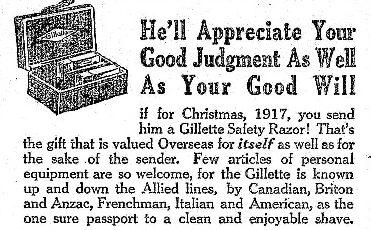
But where is he gonna get the blades???

However it originated, the razor-and-blades model was a good idea. It increased Gillette’s profits back then, and it’s been a mainstay of a bunch of other industries — printers-and-toners, consoles-and-games, Kindles-and-ebooks.

And that’s not all. In a slightly different form, razor-and-blades is also a part of the information publishing world.

For example, when companies like Agora are selling their financial advisory newsletters, they don’t focus their marketing on the newsletter itself. Instead, they focus it on a sexy bonus — which is given away for free — when you subscribe to the newsletter. Typically, even if you unsubscribe from the newsletter, you get to keep the bonus.

As an example, look at the End of America. This was a massive promotion for Stansberry Research, an Agora subsidiary. After spending an hour convincing you how American society is about to collapse because the dollar will soon be devalued, this promotion offered several related bonuses.

The End of America promotion keeps changing to adapt the bonuses to current needs and fears. The version I saw offered ones like “The Four Investment Assets You Do Not Have To Report To The U.S. Government” and “The Gold Investor’s Bible”. You got these intriguing titles free, once you subscribed to Porter Stansberry’s investment newsletter.

I thought of this today because I’m working on a sales letter for a crypto investing membership program. The essence of this membership program is tried-and-true wisdom about investing, culled from books written by the likes of Warren Buffet, along with a review of the current state of the crypto market. Good stuff, but not too stirring.

So I recommended a razors-and-blades model to the guy behind the course. In his case, I think something along the lines of “Top 3 Crypto Investment Opportunities For Q4 of 2018” could work well.

This doesn’t have to involve a lot of work. For example, for this membership program, the current market reviews this guy does already have this “Top 3” information. It simply needs to be pulled out, labeled with a sexy title, and given away to anyone who’s interested in trying the membership course.

How to lift the fog of procrastination

Cal Newport, a computer science professor who also writes about productivity, once had an interesting theory about procrastination. In Cal’s own words:

“The evolutionary perspective on procrastination, by contrast, says we delay because our frontal lobe doesn’t see a convincing plan behind our aspiration. The solution, therefore, is not to muster the courage to blindly charge ahead, but to instead accept what our brain is telling us: our plans need more hard work invested before they’re ready.”

(Put simply, we procrastinate when we don’t have a convincing plan.)

When I first read this theory, I thought it was flat-out stupid. I can’t remember why I disliked this idea at first. Nonetheless, it stuck in my mind, and it’s grown on me with time.

That’s because I’ve noticed it’s exactly what’s happening whenever I procrastinate. If I’m ever vague on my strategy for moving forward, I might be able to force myself to move for a while. Pretty soon though, I find I can’t get myself to move at all.

I’ve also noticed the inverse. That is, I’ve noticed that when I improve on my plan, when I clean it up and make it tighter, then suddenly I’m energized to get to work. Seemingly complex problems often resolve themselves simply by writing down what needs to be done, and then putting those tasks in some kind of sensible order.

It’s like a driver in a fog. With nothing to guide him, the driver will eventually slow down and stop, confused and disoriented about where he’s going. However, if there are nice white lines painted on the ground showing where the road goes, he can move forward — slower than in perfect weather, but forward, nonetheless.

Keep your eyes on the lines and you’re fine

Incidentally, this is how I managed to write a 15-page sales letter recently in just a few days. After about a week of research, I wrote an outline, broke it up into sections, arranged the sections into a list of alternately important and easy things to do, and chugged away down the list, without thinking too much along the way.

This is the difference between being fast and not ever finishing. If I had tried to simply sit and write, it wouldn’t have just taken me longer. Odds are, I would have gotten bogged down completely, and not moved past the first two or three pages.

Stressing out at exam time in Copywriting High

Imagine you’re back in high school and you have an important exam coming up.

You know that if you don’t get at least a B, your parents will beat you, your dog will leave you, and nobody will go with you to prom.

So what do you do? Naturally, you refuse to study for your exam. Or rather, you put off studying until you only have time to cover about 30% of the material that’s likely to show up on the test.

Of course, on exam day, you’re panicking. Your mind races forward and sees how horrible life will be when you get an F: the beatings, the dog breakup, the lonely nights.

Your mind then jolts back to the past, and to all the time you could have spent studying. Anger mixed with guilt boil up inside of you.

As you’re cursing yourself, the teacher appears and hands out the exams. You look at the first question with disgust and find…

You know the answer.

Then the second question. It’s also something you studied.

And so on with the third and the fourth questions. Before you know it, you’ve finished the exam. The nightmare is over, and somehow you survived.

When the grades come out, it turns out you got an A. The parents put the bat away. Your dog doesn’t leave. And you find somebody nice to go to prom with.

So what’s the lesson?

Well personally, I think the lesson is you still should have studied, and you should study in the future. For one thing, you might not be so lucky next time. For another, all the stress and worry outweighed the joy of procrastination.

And here’s why I’m inventing this little allegory.

Since I’ve been working as a copywriter, I’ve gradually developed certain criteria for the kinds of clients I take on.

For example, I don’t accept rush jobs. I don’t enjoy the stress they bring. Plus, rush jobs tend to signal bad things about the client.

I also don’t work with clients who aren’t likely to get value out of my copy, regardless of how good I make it. That could be because they have a bad offer, or because they don’t have any traffic, or because they don’t know what they’re doing and they won’t even use my copy.

Well, recently I took on a client who failed to meet both of those common-sense criteria. The fault was mine — I accepted the job before I got the full information about the client and their situation. And because the promised pay was good, I refused to call off the project once I figured out what was going on.

Inevitably, the project caused me a lot of stress. All along the way, I was cursing myself for ever having accepted it. What’s more, the big money I was promised also became uncertain.

Long story short, the project finished. I managed to do a good job with the copy in spite of the rush. I delivered my work, the client paid me as agreed, it appears they are satisfied with the result, and they might even get their money’s worth, in spite of fundamental problems with their marketing efforts.

So what’s the lesson?

Well, just like in the allegory above, it would have been better to do the right thing and stick to my principles. It seems I got lucky this time, and the project worked out well. I might not be so lucky next time. And in retrospect, I don’t think the stress was worth it anyhow.

A classic Hollywood trick for stronger sales letter leads

Frank Capra was desperate.

He reached for a lighter, struck up a flame, and set fire to his new film.

The year was 1937, and Capra had just finished shooting a new movie, called Lost Horizon. At the time, Capra was already a huge Hollywood success, having won the Academy Award for best director twice. However, this new film was long (three and a half hours), confusing, and test audiences hated it.

The legend goes as follows:

After the first sneak preview, which was a complete failure, Capra started agonizing. How to fix this monster of a film?

In a moment of inspiration, he hit upon the shocking solution. Even though it was dangerous and possibly crazy, he burned the first two reels of his film. This eliminated the dull intro scenes, and put the audience smack in the middle of the action.

Problem solved.

I thought of this Hollywood legend because I’m currently writing a new sales letter. It’s for sun-protective clothing, and the angle for the sales letter is skin cancer. So I decided to open with a story of a wife whose husband has been diagnosed with melanoma.

While I was planning this, I kept hearing Chris Haddad’s “Talk dirty to me” VSL in my head. It literally opens up with the words “Talk dirty to me,” and then goes to tell the story of a woman whose boyfriend made that request.

That’s some Frank Capra stuff.

Unfortunately, I haven’t yet been able to sum up my audience’s fears in such a clear and powerful phrase.

But I do start the story immediately, with the husband in the hospital bed, his wife at his side, and the doctor delivering a horrible verdict. It’s much better than beginning with a sermon about how skin cancer is the most prevalent type of cancer.

So in short, if you want a stronger sales letter lead, look to cut out some filler. Make sure to get to the dramatic stuff right away, and capture your audiences attention in the very first sentence.

Talk dirty to me…

The right way to respond when you hear “no”

“The easy part of playing negotiation is knowing when not to flinch”

Once upon a time, I threw a party and met a girl who came with some of my friends.

Throughout the evening, I circled around, talking to my various guests.

And each time I came across the girl, I could sense a growing interest from her side.  Which was great, because I was interested in her as well.

At some point, the party moved to a nearby club, where I found myself dancing with the girl. We started kissing, and eventually, I said, “Let’s get out of here.”

“Ok.”

So we got our coats and were about to walk out of the club. Just as we were at the door, she took a step back, furrowed up her eyebrows, and said: “Don’t think for a minute you’re taking me back to your place tonight.”

Thanks to being tired and a bit buzzed, I didn’t flinch at this. Instead, I looked her in the eye and said, “No problem. We’ll go to your place instead.”

She thought about this for a moment, and concluded that it was perfectly satisfactory. So we went to her place, and spent the first of many nights together.

I’ve just started re-reading Jim Camp’s “No: The Only Negotiating System You Need for Work and Home.” And here’s a relevant passage I just came across:

“If you’re a parent, you know that every child hears ‘no’ as the start of a negotiation, not the end of it. As adults, however, we’ve been conditioned and trained to fear the word.” 

I think that learning not to over-react to hearing “no” is not just good negotiation, but also one of the fundamentals of persuasion.

And just so we’re clear: I’m not talking about being pushy, insensitive, or “not taking ‘no’ for an answer”.

Instead, I’m talking about managing your own internal, emotional state, and keeping your sights on your goal in spite of the decoys being launched in front of you.

Interesting guarantees, part 1

“You’re going to like reading this post. I guarantee it.”

Guarantees are a penny-a-dozen throughout marketingworld. And even double-your-money-back guarantees aren’t so unusual. Typically though, they are reserved to fairly small offers.

Today however, I came across a version of a double-your-money-back guarantee that’s pretty enormous. I heard about it on a conference call put on by Justin Goff and Ian Stanley. Both of these guys are very successful marketers and copywriters, and they were on the call sharing their experience and answering questions about marketing.

At the end of the call, Justin made a pitch for his Beat Your Control Seminar. This is a $25k affair where he will share his 18 “control beaters” and work with businesses to improve on their marketing funnels.

And that’s where the massive guarantee comes in. Justin’s promise is that he will beat these companies’ controls within 48 hours, and make them an extra $100,000 to $5 million this year. If he doesn’t, he will write them a check for double the money they spent to attend — a $50,000 guarantee.

Now I’m not sure whether Justin is really so experienced that he can beat every control out there. Or whether it’s a marketing strategy. Or whether he is simply ok losing that money with a few customers because he will recoup it with others, especially down the line.

Perhaps he’s simply counting on the quality of information that he’s sharing, and on his skills as a consultant, so that for anyone who attends his seminar, the promise and the guarantee will become irrelevant.

I remember reading something similar about Gary Bencivenga. When he joined an upstart marketing agency, they ran an ad in the Wall Street Journal that said they will run a test — either they beat your control or they will refund your ad spend costs. Apparently they got a ton of business from that ad, but nobody was interested in running the test — they just wanted to hire Gary’s agency outright.

A similar offer from 40 years ago.

Anyways, Justin’s guarantee was big and specific and impressive enough that I wanted to record it, in a similar way that I recorded an interesting offer last time. I’ll keep recording interesting guarantees and offers going forward. Which brings to mind something else Gary Bencivenga wrote:

So, Top Gun, what “red shirt” should you be looking for in your marketing campaign? What do you think is the one thing that could most easily double your response? A breakthrough headline? Hot new premium? A lapel-seizing lead for your letter?

Decide what it is, then start looking for it today. And don’t close your eyes until you find it.

Creative offers, exhibit 1

I was talking to a friend yesterday and explaining how I’ve been doing well with sales copywriting.

“So what’s the trick to success?” he asked.

“Honestly, I said, “it’s to work with a client who’s got a great offer that people love. Even mediocre marketing will sell a great product easy, while brilliant marketing won’t sell a bad offer.”

I guess I must have internalized that from Gary Halbert, who put it this way:

Know this: Strong copy will not overcome a weak offer but…

In Many Cases, A Strong Offer Will
Succeed In Spite Of Weak Copy Written
By Marketing Morons!

In this vein, I decided to start collecting creative and interesting and effective offers that I come across.

The first of these is from Matt Stone AKA Buck Flogging. Starting with his 180 Degree Health blog, Matt has had a a bunch of successful online businesses over the past decade.

(I’ve been on Matt’s various email lists for a while, and aside from Ben Settle, I think he has some of the best emails, even though he only emails when he wants to pitch something. Unlike Ben, though, Matt isn’t a copywriter by trade. He simply honed his skill by tireless writing of books and blog posts and emails and managing the herds of people who interact with him daily.)

A couple of years ago, Matt made a course where he shared his approach to starting an online business and having it make money. Interesting — due to Matt’s history of success online — but pretty standard so far.

Here’s the creative bit about this offer comes in. Matt made the price of his course flexible. How flexible? It was one day’s wage, whatever that may be for you.

The list price was $300. But right in the email where he was announcing the course, Matt sent a bunch of coupon codes for discounts from 10% off to 90% off. He even had a “BANGLADESH” coupon code, which I presume reduced the cost down to a dollar or so.

Could this possibly work? I remember getting this email and being almost instinctively carried away to buy the course on the spot. I didn’t, because I figured I simply wouldn’t use it at that time.

However, I did buy the next year’s version, in part because I remembered this email from a year earlier. And during that version of the course, Matt shared that this particular offer, and this particular email, were one of the most successful he ever ran. So I’m filing it into my drawer of creative (and successful) offers as example no. 1.

How to nail a wise old doctor’s voice

I’m currently working on an email sequence for a memory enhancement supplement.

The spokesperson for this supplement is a doctor — male, white, I estimate in his mid-60s, with a pleasant Southern drawl and a wise grandfatherly demeanor.

“I’ve always had a love of nature and natural remedies”

I wrote up the first batch of emails and delivered them to my client (the supplement company owner, not the doctor).

“The angles and topics are all good,” the client said, “but can you work on adopting the good doctor’s voice a little more?”

Honestly, I was a bit miffed at this, because I already had tried to adopt his voice (as I do with all copy that I write). I had gone through the transcripts of an interview I had with the doctor, as well as several videos he had done on YouTube where he talked about health and supplements.

The trouble was, while the doctor did have a characteristic “voice” while speaking, when written down, there wasn’t nearly as much there. He wasn’t really using any unique slang, or technical terms, or telling lots of personal stories.

What to do? I swallowed my pride and rewrote parts of the emails.  Here’s what I did:

1. Use some generic conversational patter

I always try to write in a conversational way. In this case, I amped it up even more using generic conversational fluff, such as:

“You know”
“Well, what I’m talking about here is”
“Now I’ve got to warn you”

2. Search more closely for stories and phrases

I went through all the transcripts a second time, and I did find some phrases that were subtly unique. I wrote them all down, and one by one, I made sure to find a place in the copy to add each of them in. Here are a few examples:

“I’ve had an awful lot of success”
“Boatloads of medicines”
“It’s a jewel” [when describing something valuable]

3. Add parenthetical remarks

These are simply moments to step back from a story, an explanation, or a pitch, and you talk one-on-one, give an opinion, a personal comment, or insert a tiny other story.

For example, when talking about one of the ingredients in this supplement, I took a step back to have the doctor say, “You see, since I was a youngster, I’ve always had a love for nature and natural remedies. That’s why…”

4. Insert consistent stories and illustrations

This is perhaps the most impactful of all of these techniques.

I decided to simply add in stories and illustrations and images that are consistent with the persona of the doctor, even if it’s stuff I never really heard him say, and even if it’s stuff he might not actually ever say.

For example, I told the story of a “beautiful and stately old tree” down the street from where the doctor lives, which happens to be a ginkgo tree, one of the ingredients in the supplement. And I used grandfatherly images like the following:

“His anger issues started disappearing like mist in the morning sun”
“She had a vice-like grip on her intelligence again”

So did all this work? Who knows. But the client was happy, and he wrote back right away to say I had nailed the doctor’s voice perfectly.

A clever persuasion tactic from a 1970s racist lackey

Here’s a bit of movie trivia:

Woody Allen has won the Academy Award for best original screenplay three times. Twice, he did it alone. Once, in collaboration with Marshall Brickman.

Francis Ford Coppola has also won the same award three times, as have Billy Wilder and Charles Brackett. Each of them has shared at least one of those awards.

Only one guy has ever won the Academy Award for the best screenplay three times, working entirely by himself.

That guy is Paddy Chayefsky.

Right now, I’m rewatching my favorite Paddy Chayefsky Academy-Award-winning movie. It’s called Network, and it deals with the network TV business in the 1970s.

Halfway through the movie, Diana Christiansen, a heartless new breed of TV exec, meets with a representative of the Communist Party of the United States, Laureen Hobbs, in order to discuss making a program based on live recordings of acts of political terrorism. This is how the introduction goes:

Diana Christensen: Hi. I’m Diana Christensen, a racist lackey of the imperialist ruling circles.

Laureen Hobbs: I’m Laureen Hobbs, a badass commie nigger.

Diana Christensen: Sounds like the basis of a firm friendship.

Clever, right?

“Allow me to disarm you with my honesty”

This introduction does a few things well. For one thing, Diana agrees with what Laureen already believes (the Marxist idea of “class for itself”). At the same time, the introduction is entirely and brutally honest, almost self-dismissing. It’s also very different from what is expected, immediately stirring curiosity and buying a bit of time.

This kind of strategy is what negotiation coach Jim Camp called a “negative stripline.” A negative stripline is when you go fully negative on some sensitive point, to the extent that the other side feels a bit bad and wants to reel you back in towards more middle ground.

So how can you use negative striplining in marketing?

Well, if you’re sending out cold emails to prospect for new customers, you could try opening with something like:

“Hello, my name is John Bejakovic and all I really want is some of your money. However, since I don’t have the skills to rob you, I have to offer you something you’d value in exchange. In my case, the only thing I know well is sales copywriting.”

If you’re selling an ebook about aromatherapy (as I plan to do soon), you could start off the sales letter by saying:

“There’s been a lot of hype about essential oils, and most of it has zero basis in reality. In fact, essential oils have on occasion hurt people who tried using them. And yet, there are cases when essential oils are not completely worthless, and can even be used safely.”

If you’re selling a probiotic:

“The human gut is enormously complex. Scientists know only a little about the myriad interactions between gut bacteria, other species of gut bacteria, and our own bodies. Odds are, they won’t have a good idea about it for another 100 years, and there’s no way to make any firm recommendations right now. However, if you want to self-experiment as a way of fixing your digestive issues, then this probiotic might be worth a look. Here’s why.”

I’ve never written anything this extreme for any of my clients. I don’t know if it would work. But if you want me to write something brutally honest (and possibly disarming) for your business, here’s where to go.

6 ways to stir up curiosity (cont.)

Onwards and upwards. Continuing from my post yesterday, here are 3 more ways to create and amplify curiosity:

4 Flaunt the velvet pouch

When it comes to copywriting, the method of the velvet pouch is possibly the sexiest, most effective, and most profitable way to create curiosity. It certainly seems to be very prevalent on the Internet today, particularly in long-form sales letters and VSLs.

In many ways, the velvet pouch idea is a combination of several of the techniques from yesterday’s post. But I also feel like this method is tapping into human psychology on some unique, fundamental level, and that’s why I decided to include it on its own.

I found out about the velvet pouch technique from Michael Masterson’s and John Forde’s Great Leads. Here is the relevant section from the book, which is talking about lesson from a door-to-door salesman named Harry:

After gaining admittance to the apartment, Harry would start his pitch about the quality of our cookware, taking out the pots and pans individually from the case. But they were each encased in plush, royal blue velvet pouches. As Harry described the features and benefits of the cookware, he would gently massage the pots, first from outside over the velvet pouches, and then by slipping his hands inside them but still keeping them hidden from the prospect.

“Just keep your eye on the customer,” he told me. “In the beginning they’ll be looking at you. But as you go on, you’ll notice that they will shift their focus to the pots and pans. That lets you know they are getting interested. Keep hitting them with the benefits while they stare at what you’re doing. And never, ever tkae the pots out until you know they have the prospects’ full attention.”

Masterson and Forde use this story to kick off their chapter on what they call the secret lead. In other words, the velvet pouch is all about the mystery and intrigue that builds up when a secret is hovering around in the air.

In some ways, this is similar to a combination of the open loop and the teasing from yesterday. But like I said, there also seems to be a fundamental human hunger for secrets, even if they aren’t clearly associated with any benefits. I think that also explains why “secret” and “mystery” are marketing power words that can in many ways make a headline on their own.

By the way, I think trying to disqualify yourself (or what you’re offering) can sometimes work in the same way as a secret. Once something is taken off the table, people suddenly become more intrigued by it. That’s why I think the start of my post from two days ago is in some ways also a secret lead:

Fair warning: the following post contains some sexual, politically incorrect references. It might offend some people.

It’s ok to click away. But if you insist on reading, here goes:

5 Be different


6 Be new/Share news

The new kid on the block

When Gary Halbert died, Gary Bencivenga wrote a post explaining why Gary H.’s newsletters were so interesting. The number one thing, according to Gary B.?

1. Gary shared news. Sometimes he was the news, sometimes it was a dramatic turn of events in his tumultuous life, but often enough, he shared news of a technique or strategy that would make your response and profits soar. You couldn’t afford to miss even one of these gems, so you had to open every issue.

Many times, being new is sufficient unto itself, even if there’s no implied benefit, and not even anything clearly different. Novelty seems to directly tap into human psychology. Remember being in elementary school when a new kid appeared in class? Like in the photo above, that new kid was automatically interesting, at least for a while.

About number 5 above…

I tried to be different with the “be different” section above, so I didn’t expand on it at all. Maybe I should have just left it at that, because being different can be pretty straightforward. Still, here are a few examples:

First off, there’s the picture from yesterday’s post: “WORLD’S ONLY FEATURE DANCER WITH 3 BOOBS.” Is it a benefit? Hardly. A secret? Not at all. Just morbid fascination and curiosity with something different.

Second, there’s the story I started with two days ago, about a guy named Yad sleeping with a girl only a few hours after meeting her — just because he was different enough from other guys to make her very curious.

Finally, a copywriting example from my own essential oils list. At one point, I was promoting an online video series about longevity. The promise of the series was “How to live to a happy and healthy old age.”

That’s a fine benefit, but everyone is already pushing the same. So I simply switched it around to be different. I retold an ancient Greek myth about a Trojan prince who gets eternal life but not eternal youth, and how it turns out to be a curse rather than a blessing. The subject line for this inspiring email: “How to reach a frail and unhappy old age.” It worked pretty well.