
Excuses for the perfect murder

“Come on Bobby, get in the car! We’ll give you a ride!”

“No, Dickie. It’s just a couple blocks. I’ll walk.”

“Get in Bobby! Quit being such a wet blanket! I want to show you my new tennis racket!”

On May 21 1924, two Chicago teenagers, Nathan Leopold and Richard “Dickie” Loeb, rented a car. It was the first step of their plan for the afternoon’s perfect crime.

Leopold, a former child prodigy, was 19. He had just graduated from the University of Chicago and was preparing to enter Harvard Law School.

Loeb was 18. A year earlier, he had graduated from the University of Michigan as the youngest graduate ever.

Leopoold and Loeb drove slowly down the street. They spotted their chosen victim. 14-year-old Bobby Franks, Loeb’s second cousin.

It was supposed to be the perfect murder. A demonstration that Leopold and Loeb were supermen. Because Leopold was a big reader of Friedrich Nietzsche. He was fascinated by Nietzsche’s idea of the superman — the rare, unusually gifted man who can rise above common morality.

Besides, Leopold thought, he and Loeb were too smart. They had planned everything. Nobody could ever catch them.

Leopold and Loeb cajoled Bobby into the car. A few moments later, they knocked him out with a chisel, dragged him to the back seat, and strangled him.

​​They then disposed of the body in a pre-planned location, 25 miles south of Chicago. They washed the upholstery of the car and went on with their lives.

“Err… fascinating stuff, Bejako,” I hear you say. “But why are you creeping me out? Where is this story going?

All right, let me get to it.

Yesterday, I talked abut a squeaky-clean guru who seemed to blatantly lie about his backstory to please the audience. I promised to wrap that email up today.

So the first half of what I want to tell you is:

Sell a transfer of responsibility.

Because Leopold and Loeb did not succeed in carrying off the perfect murder. An act of Providence interfered.

Loeb’s horn-rimmed glasses slipped out next to the body of Bobby Franks. The glasses had a custom hinge that could be traced back to only three people in Chicago, Loeb among them.

At the subsequent trial, Leopold and Loeb’s lawyer focused all his efforts on avoiding the death penalty. He gave a 12-hour-long closing statement, which has become a classic of American law. He supposedly brought tears to the judge’s eyes.

The lawyer managed to keep Leopold and Loeb from the gallows. He persuaded the judge to spare them in spite of the gruesome and senseless crime… in spite of the innocence of the victim… and in spite of the public outcry for the two young supermen to be hanged.

So how did the lawyer do it?

First, he admitted that Leopold and Loeb had done the deed.

And then, over those 12 hours, he explained the real blame lay at the feet of Loeb’s domineering governess… of nature and evolution… of bloodthirsty newspapers… of callous university professors who exposed the two teenagers to ideas they were not ready for… of the Macmillan publishing company and its reckless spreading of inflammatory books… and of course, of Friedrich Nietzsche.

In other words, the deed might have been Leopold and Loeb’s. But the fault was everybody else’s. And the judge bought it.

Just imagine:

If an appeal like this can sway an impartial, third-party, external judge… what can it do for a partial, first-party, internal judge?

That’s what I’m talking about. Transfer of responsibility.

That’s why smart marketers find ways to take that internal judge in the prospect’s mind.. and show him how all those bad outcomes in the past are everybody else’s fault. And not only that.

Smart marketers also make the prospect believe any possible bad outcomes in the future won’t be his fault either.

But perhaps you’re worried about the bad future outcome of this email never finishing. So let me really wrap it up.

My conclusion is that a transfer of responsibility is something you want to sell to people…

But it’s not something you want to buy yourself. Or at least I don’t.

Because I’ve learned from direct marketing how powerful this drive to escape responsibility can be. And I’ve since noticed it in myself as well.

I’ve also learned that trustworthiness and authority can be easily bought online.

That’s why I’ve made it a personal policy not to get attached to online personalities. Even the ones I like and feel I can trust.

Of course, I consider their ideas. But I take on the responsibility of deciding whether these ideas are something I should believe in and act upon… or not.

Perhaps that’s a policy that makes sense for you to adopt as well. And you know. Not because I say so.

Last thing:

If you like reading Friedrich Nietsche, you might like my email newsletter. Here’s where you can give it a try.
About those “nice and genuine” gurus…

I got the following earnest question a few days ago:

“Among all of the A-List direct response copywriters that you’ve been able to meet, who was the nicest and most genuine? And did he/she share a golden piece of advice that made a difference in your development as a writer/marketer?”

As for the one golden secret whispered to me by an A-list copywriter… there was none. I studied the same stuff that’s available to everyone, much of it for free or in affordable old books.

But as for that nicest and most genuine part… well, let me tell you a story. I’ve told this story before, but it seems to need repeating.

Some time ago, I found myself in a semi-private setting with a successful online guru. I won’t say who he is or what he sells. But I will tell you he is a genuinely nice guy. Warm, cheery, helpful.

And not only that. He’s also very clean-cut. A true family man, very devoted to his faith.

So in this private setting, I listened to this guru tell his origin story.

It was dramatic, inspiring, and really ideal for that setting. I won’t retell it here because I don’t want to identify the guy. But let me compare it to the first time the Joker tells his backstory in Christopher Nolan’s The Dark Knight:

“You wanna know how I got these scars? My father was a drinker and a fiend. And one night…”

A few days later, I heard a recording of a different semi-private event. One I had not attended. It featured the same genuinely nice, clean-cut guru telling his rags-to-riches origin story.

Again, I won’t retell it here. But it’s comparable to the Joker saying a bit later in the movie,

“Do you wanna know how I got these scars? So I had a wife who tells me I worry too much…”

In other words, the story finished in the same place. But all the details, big and small, leading up to that point, were different.

A completely different origin story. Incompatible with the first version I had heard. But again, perfectly fitted to this second environment.

So what’s my point?

Rather than spelling it out, I’d like to invite you to draw your own conclusion today.

But if you really want to know the unsettling lesson I take away from the story above… well, I’ll share that with you in my email tomorrow. You can sign up here if you’d like to read that.

Hidden desires of would-be copywriters

Last night, a friend sent me an interesting article that Kevin Rogers of Copy Chief had written. The article is about MMA fighter Conor McGregor and features 14 points — a lot. The one that stood out to me was this:

#2 – Know what your audience REALLY wants.

Do you really know what your audience wants? Most people think they do, but there are often subtle differences in what they want… and what they REALLY want.

In the UFC winning is not enough. Sure, Conor is a professional fighter, and fans like to see wins.

But what the audience and organization REALLY want is a “finish”. They want to see one competitor knocked out cold on the canvas.

Hidden desires. Hidden from the world. Hidden from ourselves.

Maybe you think that the desire to see somebody knocked out isn’t so hidden. Fine.

So here are a few more tricky and subtle examples of what some markets REALLY want. They come from copywriter Chris Haddad:

1. Numerology. Not really about divining the future or understanding the universe. People in this market really just want to feel special.

2. Bizopp. Not really about the millions or even the lambo. People who go for these offers really just want to feel competent… and wipe the smug, dismissive look off their brother-in-law’s face.

Which begs the question… what do people in the “become a copywriter” niche really want?

For many of them, it’s not about making money… or writing as a new career… or the independence that comes with this job.

I know this for a fact. Because there are proven and well-trodden paths to success as a copywriter. But in spite of knowing the path, these people never take the first step. And if they take the first step, they never take the second.

I’ll be honest with you:

I don’t know what these people are really craving. Not on a primal level. Maybe you have some ideas and you can tell me.

Or better yet, maybe you don’t know either… because you yourself really are after the money, the new career, or the flexibility and freedom.

If that’s the case, I can point you down a well-trodden path to success. The path that I’ve personally taken. I’ve written up all the directions inside a little guidebook I’ve titled:

“How To Become A $150/hr, Top-Rated Sales Copywriter On Upwork: A Personal Success Story That Almost Anyone Can Replicate”

This book has my best advice for the early years of being a copywriter, whether you’re on Upwork or not. The how-to info inside is underpriced by a couple of factors of magnitude.

And as I wrote last night, I will be retiring this book permanently in a couple of hours. Depending on when you’re reading this email, the book might already be gone.

One final point about this $5 investment:

The information in this book won’t transform you into a copywriting success. You gotta take those steps yourself.

But if you are willing and able to put one foot in front of the other… then this book will point the way. Plus it will give you valuable tips and shortcuts it took me several years to discover.

​​So if you’ve got $5, and you want this before it disappears, here’s where to go:

https://bejakovic.com/upwork ​​

Become a copywriter by tomorrow

Yesterday, reader Michael Harris wrote me to say:

I just wanted to let you know that I bought your Upwork book last week or the week before. I read it in an hour or two.

Yesterday, I got around to updating my profile and began bidding on jobs. Today, I closed my first job.

I used all of your tips and tricks (even the ‘hack’ you removed from the book) and landed a job in a day.

Full disclosure: I’m not new to copywriting, but I am new to Upwork as lead generation. The rate for this job is dog shit, but it’s the first step in getting started on Upwork.

I think the biggest takeaway I took from your book is this; don’t try to be clever. Just give them what they want, as long as it’s the truth.

My proposal was about 3 sentences long. Nothing fancy. Just what they wanted to see. 15 minutes after I sent the proposal I’d been hired. Nice.

Thanks for your help John

My point is, becoming a copywriter doesn’t have to take years. Even months.

You anoint yourself in this field. You can do it from today to tomorrow.

“Whoa there John. Can’t you read? Michael said he was already a copywriter and just using this as new source of leads.”

If that’s what you want to focus on, so be it. But let me offer another perspective:

Back in 2013, after wining his UCF debut, future two-division champion Conor McGregor gave an interview. McGregor is a master of self-promotional boasting and bluster, on a level that matches former President Donald J. Trump.

And yet, here’s what McGregor had to say about his confidence and invincibility:

“I’ve lost MMA fights. I’ve lost boxing fights. I’ve lost so many fights in the gym. I lose all the time. It is what it is. Any true martial artist will know in order to succeed at this game you must lose a fucking shitload of times.”

The good news is, you’re not aspiring to be a pro MMA fighter. You don’t need to risk getting your leg snapped in two. You don’t need to get your head kicked in. You don’t even need to expose your soft throat to strangulation until you’re an inch away from death.

The worst that can happen to you is you write something… the client comes back, tearing his hear out (not yours) and screaming, “What is this mess? Who told you you could be a copywriter?”

Tell ’em it was this guy, John Bejakovic, whose email newsletter you read.

And once your emotions subside in a few hours’ time, then start looking for your next gig. And as you do it, think how, in the future, you can avoid the big mistakes you made in that first job.

Again, that’s the worst case. And it ain’t all that bad.

The more likely case is, you deliver something… it’s okayish… particularly for the crap wage you’re getting paid. That’s a real success, and something you can build off.

But you know what?

You either get this or not. I’m just telling you this to be fair.

Because I mentioned a while ago that I will be retiring my Upwork book. Well, the time has come.

I will remove it from Amazon tomorrow night, after the final Influential Emails call, probably around 10pm CET.

I’ve promoted this book a few times before. It’s got my best advice for the early years of being a copywriter, whether you’re on Upwork or not. The how-to info inside is underpriced by a couple of factors of magnitude.

It’s going away tomorrow, for good. So in case you want to get it before it disappears, and maybe even apply some of the information it contains, here’s where to go:

https://bejakovic.com/upwork

A crazy and messed up way to end an email

Some time in 1981, future “Songwriters Hall of Fame” member Darryl Hall was sitting at the piano in his Greenwich Village apartment.

His girlfriend Sara was in the kitchen peeling a hard-boiled egg.

Hall had a pencil in his mouth. He played a chord on the piano. He took the pencil and scribbled down a few words on a piece of paper.

Oh here she comes… She’s a maneater… and a commitmentphobe.

“Terrible!” Hall said. He crumpled up the paper and threw it on the floor.

Sara walked into the living room. She swallowed the first half of her hard-boiled egg. “What’s up?” she asked.

“So frustrating,” Hall said. “This new Maneater thing. I have the intro. ‘She’s sitting with you but her eyes are on the door.’ Right? A little story. Everybody can picture that.”

Sara stuffed the other half of the egg in her mouth. She raised her eyebrows to indicate to Hall to keep going.

“But then I get to the chorus,” Hall said. “It’s really the payload of the song. It’s what I want the listener to take away. But I can’t find a good way to wrap it up. ‘She’s a maneater and a… dirty nasty bitch? A cruel seductive girl? A womanhater?’ I can’t figure out how to end it with something people haven’t heard before.”

Sara finished chewing the egg and swallowed. She walked to the crumpled-up paper, picked it up off the floor, and looked over the lyrics.

“Drop that shit at the end,” she said. “Go, ‘She’s a maneater.’ And stop.”

Hall frowned. Then he really frowned. “You’re crazy.” he said. “That’s messed up.”

Sara rolled her eyes and walked back to the kitchen. Hall stared at the piano. He closed his eyes. He played a few notes. And he started to nod his head.

In the end, Darryl Hall dropped the shit at the end, as per his girlfriend’s advice. Hall & Oates recorded the song a few days later.

Maneater became a number one hit on the Billboard Hot 100 chart on December 18, 1982. Out of the five number one hits that Hall & Oates had in their career, Maneater became the one that stayed at no. 1 the longest. Going by the 172 million views the song has on YouTube, it remains their biggest hit today.

“I thought about it,” Hall said once when speaking about Maneater and about his girlfriend’s suggestion. “I realized she was right. And it made all the difference.”

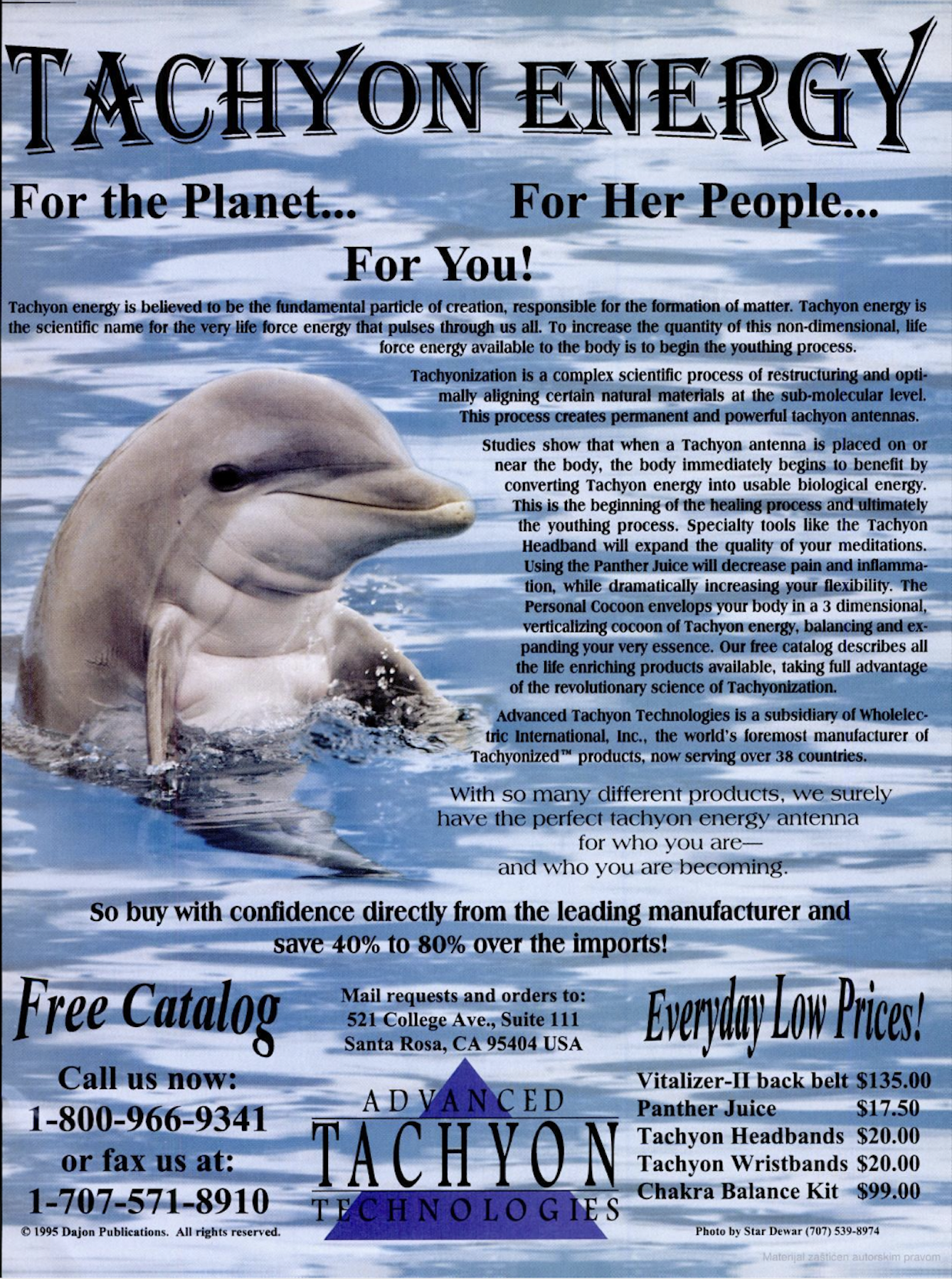
The perfect sales language for who you are — and who you are becoming

“With so many different products, we surely have the perfect Tachyon energy antenna for who you are — and who you are becoming”

A picture of a dolphin. “Panther juice.” And the following headline:

TACHYON ENERGY
For the Planet… For Her People… For You!

It might be the strangest direct response ad I’ve ever seen.

In fact, I’m not really sure it is a direct response ad. Maybe nobody was checking the responses. Or maybe this was actually a communique from wise creatures in a parallel dimension, who want us all to live in greater harmony, health, and prosperity.

What I do know is that this ad appeared dozens of times in the 90s and 2000s in magazines like Yoga Journal.

Some of the products listed in the ad include back belts, headbands, and something called “panther juice,” all of which purport to tap into the mysterious tachyon field all around us.

I’d never heard of tachyon energy before.

But I soon found that the people behind the dolphin ad had published a book in 1999 to explain tachyon energy to the masses. The book has 63 reviews on Amazon. Here’s a short excerpt from the most upvoted review:

“I came across Tachyon while doing some research on Vogel Crystal healings. Radieshesia, Radionics, Psychotronics etc all lead you to a Parallel dimension ( Dr. Tiller calls it a second 3D) we can tap into. Zero Field, Dark Matter, The Field, Quantum Field, whatever you want to call it, it is there and various people have learned and figured out how to tap into it.”

I’m not 100% sure what my point is. Except a while back, I wrote this:

Look to the extremes.

In other words, if you want to harness a valuable copywriting technique or marketing approach… then look to the folks who specialize in this approach — and nothing else.

For example, if you want to frame your offer as a huge opportunity… then look to opportunity marketers. The real estate infomercials… the business opportunity classifieds… the Joe Karbo’s of the world.

And if you want to create an aura of magic, mystery, and otherworldly possibility in your copy, then look to the tachyon energy ad and the sales language it uses.

Either it will help you write copy that taps into the fundamental human need to believe… or it might teleport you into a non-dimensional space and provide revolutionary new answers to health, longevity, and mental alertness.

Whatever the outcome may be, if you’re ready to have your third eye opened, then take a look below. And if you want an email newsletter about copywriting and marketing that’s perfect for who you are — and who you are becoming — then step through this portal.

An open letter to an internet detective who caught me sneaking yesterday

Yesterday, I wrote an email which referenced something Ben Settle said a few days ago. Big mistake.

Because one vigilante detective on the Internet immediately sensed something suspicious was afoot. So he reached through the screen… grabbed me by the scruff of the neck… and started investigating where I’ve been the past few days. He wrote:

“The other time John Bejakovic said he was unsubscribing from Ben Settle’s email list. I wonder how he still managed to get wind of an email Ben sent few days ago.”

Ever since my teenage days, I’ve loved explaining my comings and goings to other people. So as a way of explaining myself this time, let me tell you a fun Dan Kennedy story.

Many years ago, Dan worked with a client named Tom Orent. Orent is a marketer in the dentistry niche.

One of Orent’s offers was a yearly $48k coaching program. (By the way, this was back in the early 2000s. Think more like $200k in today’s marketing money.)

So at a seminar one time, Dan got a question from an intrigued audience member. “What the hell does Tom Orent do in his coaching program to justify the $48k price tag?”

Dan chuckled. “First of all,” he said, “let me suggest a better question. Rather than, what the hell does Tom Orent do to justify his $48k fee… the better question would be, how does Tom Orent sell his $48k coaching program. Because the sales mechanism is far more useful for you to discover than what is being delivered. However, since you asked the wrong question, you get the answer to the wrong question…”

And then Dan laid out the pretty uninteresting content of Tom Orent’s $48k coaching program.
​​
Similarly, here’s my explanation of my whereabouts over the past few months:

I did unsubscribe from Ben Settle’s print newsletter this summer. That’s what I wrote about in a series of emails a short while ago.

But I never unsubscribed from Ben’s emails. That would be foolish, even by my standards. Because like Dan says, the sales mechanism is far more useful to discover than what is being delivered.

But really… that’s not why I keep reading Ben’s emails.

I bet you’ve got a bursting swipe file already. I know I do. And so the real reason why I still subscribe to Ben’s emails is not so I can stuff more word tonnage into my swipe file, like a little squirrel with its cheeks full of acorns, trying to fit just one more in there.

No, I read Ben’s emails for another reason. Again, here’s Dan Kennedy:

“Put your best stuff in your lowest-priced stuff.”

I don’t know if Ben goes by this. But I’ve personally found a lot of tactical, business, and personal value in Ben’s free emails.

And that’s the truth, Mr. Internet Detective. That’s why I keep reading. And that’s how I got wind of Ben’s email from a few days ago. That’s the answer to your question.

But let me suggest a better question.

Rather than, how did I get wind of Ben’s email… the better question would be, how do I keep from missing out on valuable lessons that Ben hides in plain sight? And how did I recently apply some of those lessons to my business, and profit from them already?

That’s what I was planning on talking about in today’s email. ​

Because there’s no point in getting somebody’s best stuff for free… unless you recognize it as such and then do something with it. However, since I got asked the wrong question…

Want answers to some right questions? I write an email newsletter every day. You can subscribe to it here, and in that way, keep track of my suspicious comings and goings.


Introducing: New Gimme Hope Co’rona strain

Perhaps you’ve read the news. From a Reuters article earlier today:

“Australia and several other countries joined nations imposing restrictions on travel from southern Africa on Saturday after the discovery of the new Charlize Coron variant sparked global concern and triggered a market sell-off.”

Ok, that’s not really what the news said. The new corona strain isn’t called Charlize Coron. It should have been called that. But instead, it got yet another boring Greek letter name, omicron.

A couple days ago, Ben Settle wrote this:

Yes, Google is one the best content title swipe files on the internet IMO.

My recommendation:

Look at hundreds of craft beer names.

Note the ones that pop out at you.

Then ask yourself:

“How can I apply this uniquely and creatively to my next piece of content?”

Since the Greek letter naming system sucks, I decided to try Ben’s advice out. I wanted to see if I couldn’t come up with a craft beer name for the new corona variant, something better than “omicron.” Maybe you can tell me if I succeeded with any of the options below.

A bit of googling revealed that many craft beer names are puns on celebrity names, stock phrases, or pop culture references tied in to the history behind the brewery.

Since this new variant was found in South Africa and Botswana, I hit upon the following ideas for the new corona beer:

* Covid Bustard (after Botswana’s national bird, the kori bustard)

* Antigen To Zebra (“all the animals you can find in South Africa, from aardvark to zebra”)

* Gimme Hope Co’rona (after the Eddie Grant hit Gimme Hope Jo’anna — Jo’anna is Johannesburg)

A second article I read said scientists are worried because this new strain has “a very unusual constellation of mutations.”

Unusual mutations? That makes my brain go in one direction only. Teenage Mutant Ninja Turtles. And since craft beers often feature nonsensical, goofy, high-energy names, this could be another possible name for the new brew:

* Cowidbunga!

Finally, the scientist who isolated this new variant said the “full significance of the variant is uncertain.” This reminded me of something Daniel Kahneman wrote about uncertainty and fear:

“The fear of an electric shock is uncorrelated with the probability of receiving the shock. The mere possibility triggers the full blown response.”

This Kahneman idea ties in well to my personal beliefs about corona. And if I had anything to do with naming the new strain, I might just give a nod to Kahneman and call it “Covid, fast and slow.”

But you know what? My point is not really anything to do with corona.

It’s not even anything to do with naming your products or content either.

Maybe you can see the point I’m trying to make. If not, then check out my email tomorrow, where I will almost certainly reveal Die Antwoord (another possible craft corona name?).

Shock and delight at a celebrity funeral

On December 3 1989, a memorial service was held at St. Bartholomew’s Hospital at the University of Cambridge. The deceased was one Graham Chapman, aged 48, who had died two months earlier from tonsil cancer.

At various times during his life, Chapman was a homosexual, an alcoholic, a member of the Dangerous Sports Club, and one of the six members of the sketch comedy troupe Monty Python.

All the other members of Monty Python were there at the service. Several of them got up to give eulogies. One of eulogizers was John Cleese, the guy behind my favorite comedy of all time, A Fish Called Wanda.

“I guess that we’re all thinking how sad it is,” Cleese started, “that a man of such talent, of such capability for kindness, of such unusual intelligence should now be spirited away at the age of only 48, before he had achieved many of the things of which he was capable, and before he’d had enough fun.”

The camera zoomed around the large hall. It settled on the other Pythons — Michael Palin, Eric Idle — looking serious and proper.

“Well I feel that I should say… nonsense,” Cleese said. “Good riddance to him, the freeloading bastard. I hope he fries.”

Yep, this really happened. During a eulogy, John Cleese said about the deceased, “I hope he fries.”

Last night, I had the second call of the Influential Emails training. Throughout this training, I’ve been talking about the similarities between comedy and email copy.

Not because you want to make your emails funny necessarily.

But because you want to surprise, shock, and even outrage people at the start. And then, pay it off in a credible and pleasing way, where the only people who leave are the ones who are either slaves to mindless good taste… or who genuinely disagree with you.

In my life, I’ve never seen a better illustration of this “surprise and delight” combination than John Cleese’s eulogy.

I won’t tell you how Cleese got out of the shocking hole he had dug for himself. But he did it, and he did it in a sweet, credible, thoughtful way.

You can see it all in the short two-minute clip below. It might prove very instructive if you want to write emails that people will 1) read day after day… 2) look forward to… 3) feel a bond with… and 4) allow themselves to be influenced by.

But be warned. This clip contains two profanities, one of which had never been spoken on television before. If that doesn’t shock you too badly, then prepare to be delighted here:

Still here? Maybe you’d like to be surprised and delighted tomorrow as well. In that case, sign up for my email newsletter.

What do you think? Is this story worth keeping?

Would you do me a favor?

I’m writing a book. I’m thinking of including the following story.

Since you may have read some of my blog already, would you read this condensed version of the story?

Tell me whether it’s up to par with my better writing. Or below it?

Of course, you’re free to not share your opinion. But if you do choose to do me this favor, I’ll be grateful to you.

So this story happened some time in the 1970s, before the PC was invented, and it has to do with a computer repair tech named Keith. (Yes, I know that’s a riveting beginning. But bear with me for a second. It gets better.)

One of Keith’s customers was a financial brokerage. They used a number of expensive computer terminals.

Each day at 1:30pm, one of these terminals would lock up. The trader who was using this specific terminal was furious. He would need to wait a bit, then reach around the machine, and restart it for it to work again.

Each day, the trader would call up Keith’s company and yell. The company would send out a tech to investigate. But the tech could never reproduce the problem that the trader was having.

What was happening was this:

Before lunch, the trader would read his newspaper. A phone call would come.

The trader would toss his newspaper on top of the computer terminal, covering the heat vent.

The beast would overheat and lock up. The trader would start cursing… restart the machine… and call Keith’s company and threaten to cancel the support contract because the stupid thing crashed yet again, at the worst possible moment.

And then one day, Keith was at the brokerage dealing with another issue.

Out of the corner of his eye, he saw the trader tossing the newspaper on the heat vent… the terminal overheating and locking up… the trader getting furious, restarting the computer, and beating it with the newspaper.

Keith could have gone over and said, “Problem solved! It’s because of your newspaper! Don’t ever put it onto the heat vent like that! The machine can’t work when you make it overheat!”

No, Keith was more subtle. He walked over to the trader’s desk and said it was great he could see finally the problem for himself.

As the machine was restarting, Keith surreptitiously put the newspaper over the vent again.

Sure enough, in a couple of moments, the terminal locked up again.

“You see!” the trader said triumphantly. “There it goes again, the piece of…”

Keith shook his head and scratched his chin. He looked at the terminal screen. “It makes no sense,” he said. “You see how it flickered just then? That usually means it’s overheating. But your office is so cool… what could it be?”

Keith started fumbling with the back of the terminal. And he waited.

“Oh no,” the trader said. “Could it maybe be the newspaper?” He picked it up off the vent and a volcanic heat rose from underneath it.

In a few moments, the computer cooled off and started working again.

The trader started apologizing. But Keith would have none of it. He just thanked the trader for finding the root cause of the bug. And the support contract, instead of being canceled, ended up being extended.

So what do you think? Is this an interesting story? I’m thinking to use it to illustrate this golden insight by Robert Collier:

“As to the motives to appeal to when you have won the reader’s attention, by far the strongest, in our experience, is Vanity. Not the vanity that buys a cosmetic or whatnot to look a little better, but that unconscious vanity which makes a man want to feel important in his own eyes and makes him strut mentally. This appeal needs to be subtly used, but when properly used, it is the strongest we know.”

Do you think this illustration is worthwhile? Should I toss it out? Keep it in? Write in and let me know. I appreciate your opinion and advice. And if you ever want to comment directly on anything I write, sign up for my daily email newsletter.