
Interesting guarantees, part 1

“You’re going to like reading this post. I guarantee it.”

Guarantees are a penny-a-dozen throughout marketingworld. And even double-your-money-back guarantees aren’t so unusual. Typically though, they are reserved to fairly small offers.

Today however, I came across a version of a double-your-money-back guarantee that’s pretty enormous. I heard about it on a conference call put on by Justin Goff and Ian Stanley. Both of these guys are very successful marketers and copywriters, and they were on the call sharing their experience and answering questions about marketing.

At the end of the call, Justin made a pitch for his Beat Your Control Seminar. This is a $25k affair where he will share his 18 “control beaters” and work with businesses to improve on their marketing funnels.

And that’s where the massive guarantee comes in. Justin’s promise is that he will beat these companies’ controls within 48 hours, and make them an extra $100,000 to $5 million this year. If he doesn’t, he will write them a check for double the money they spent to attend — a $50,000 guarantee.

Now I’m not sure whether Justin is really so experienced that he can beat every control out there. Or whether it’s a marketing strategy. Or whether he is simply ok losing that money with a few customers because he will recoup it with others, especially down the line.

Perhaps he’s simply counting on the quality of information that he’s sharing, and on his skills as a consultant, so that for anyone who attends his seminar, the promise and the guarantee will become irrelevant.

I remember reading something similar about Gary Bencivenga. When he joined an upstart marketing agency, they ran an ad in the Wall Street Journal that said they will run a test — either they beat your control or they will refund your ad spend costs. Apparently they got a ton of business from that ad, but nobody was interested in running the test — they just wanted to hire Gary’s agency outright.
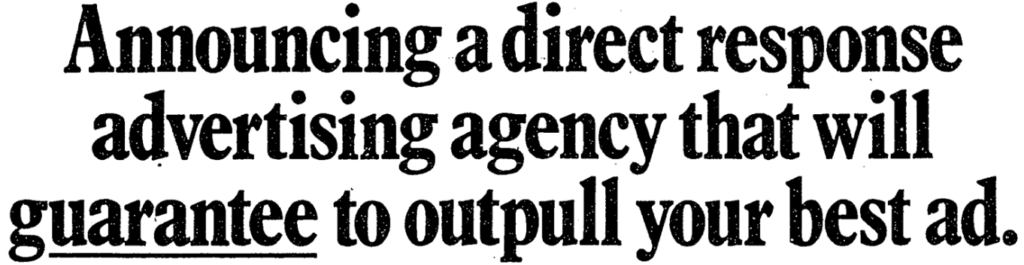
A similar offer from 40 years ago.

Anyways, Justin’s guarantee was big and specific and impressive enough that I wanted to record it, in a similar way that I recorded an interesting offer last time. I’ll keep recording interesting guarantees and offers going forward. Which brings to mind something else Gary Bencivenga wrote:

So, Top Gun, what “red shirt” should you be looking for in your marketing campaign? What do you think is the one thing that could most easily double your response? A breakthrough headline? Hot new premium? A lapel-seizing lead for your letter?

Decide what it is, then start looking for it today. And don’t close your eyes until you find it.
The case against steak upsells

“Hell yeah we’ll take five more steaks if you cut the price”

Imagine going into a restaurant. You’re hungry and you’re raring for a steak. So you look over the menu, find your steak, wince a bit at the price, but decide to get it.

“I’ll have the 12-ounce steak,” you say to the waiter. He writes this down patiently in his notebook and then says,

“Would you like 18 more ounces of our fine steak at 50% off? You can always take it home with you if you don’t finish.”

Because you’re hungry and it’s a tempting deal, you order the extra slab of meat at a discount. But of course, when it arrives, you can’t finish it. You take it home, where it becomes more of a responsibility than a joy, sitting there cold and hard in your fridge. A few days later you toss it out.

Next time, you stay away from that restaurant. Somehow, you have a bad feeling. You spent too much money. You were emasculated by not finishing the steak. And you don’t need the temptation a second time.

I’ve recently heard a couple of contrasting positions on upsells. Just yesterday, I listened to an interview with successful copywriter and marketer Justin Goff. He talked about how the best upsells are often more of the same.

“Buying one bottle of supplements? How about 3 more at a discount?”

At the same time, Justin talked about the incessant need most direct response businesses have for new customers. According to Justin, new customers are the ones who buy the product, and even the ones who take up affiliate offers. That’s position one.

Then there’s Sean D’Souza. Along with a copy of his Dartboard Pricing book, I got a copy of a talk Sean did for the Ken McCarthy’s System Club. This talk is on the topic of consumption. And one of the things Sean says explicitly is that you don’t want to overwhelm your customers with product, even if they are willing to buy it.

Sean also talks about treating customers the way you would treat your kids — that is, looking out for them and charting a path for them down the line.

Perhaps not surprisingly, Sean’s business seems to rely on a much smaller number of customers, who happily keep coming back year after year and forking over thousands of dollars for Sean’s courses and trainings. It’s what Sean calls a focus on consumption over conversion. That’s position two.

So what’s the conclusion? I guess it depends on what kind of business you’re looking to run. If you want to scale quickly and max out revenue, then aggressive “steak” upsells make sense. If you want to have a long-term business, another strategy might be better.

For example, even in Sean’s way of running a business, the right kinds of upsells can have a place.

Imagine if in that restaurant, the waiter did something different. Imagine if instead of upselling you on more steak, he recommended a special beer on tap, and his favorite salad off the menu. This would still be an upsell, though it wouldn’t make as much money as selling more steak.

Your consumption experience would be much better. You’d be more likely to return. And the restaurant wouldn’t have to constantly worry about digging up new customers.

How to sell in paid products without alienating customers

Uh oh.

My post from yesterday gave a bunch of examples of infotainment I plan to put into my upcoming book on essential oils.

But the examples I used were often taken from sales materials, rather than info products themselves.

Is this a giant screw-up on my part?

Let’s see.

Copywriting all-star Gary Bencivenga once said that sales material should be valuable enough to read on its own.

On the other hand, prolific marketer Dan Kennedy embodies the idea that paid products should also sell. (They can sell other products, or at least you as an expert.)

In other words, paid and free content can and should be quite similar. Here are a few other points to think about:

Also, former Boardroom exec Brian Kurtz talked about the kinds of premiums (aka bonuses) that Boardroom would give away with their books. What they found is that when somebody buys something, the best thing is to sell or give them more of the same. So if they are buying a health book, offer them 3 more health books as a bonus.

Finally, supplement marketer Justin Goff does something similar in the world of supplements: simply offer the buyer more bottles of the same supplement as an upsell.

And here’s how this ties back to info products or sales pages (or sales emails) that promote those products:

If somebody is “buying” your free promotional products…

In other words, if they tune in regularly to hear your personality and stories and lame jokes and whatever else you use to spice up your free promotional content, whether that’s emails, or blog posts, or speeches behind a podium….

Then it makes no sense to turn off that tap when you charge them money for an info product.

Of course, the paid product should be valuable and should close some of those loops that the free content opens. But it should continue to be entertaining (and even to sell) in the same way as your free stuff — or you will have some sore and disappointed customers.

And that in a nutshell, is why infotainment examples from sales letters — as well as more direct sales techniques — can go straight behind the paywalled curtain as well.