
3 lessons after $18,487 spent on running Amazon book ads
Over the past 7 years, I’ve spent $18,487 on Amazon book ads:
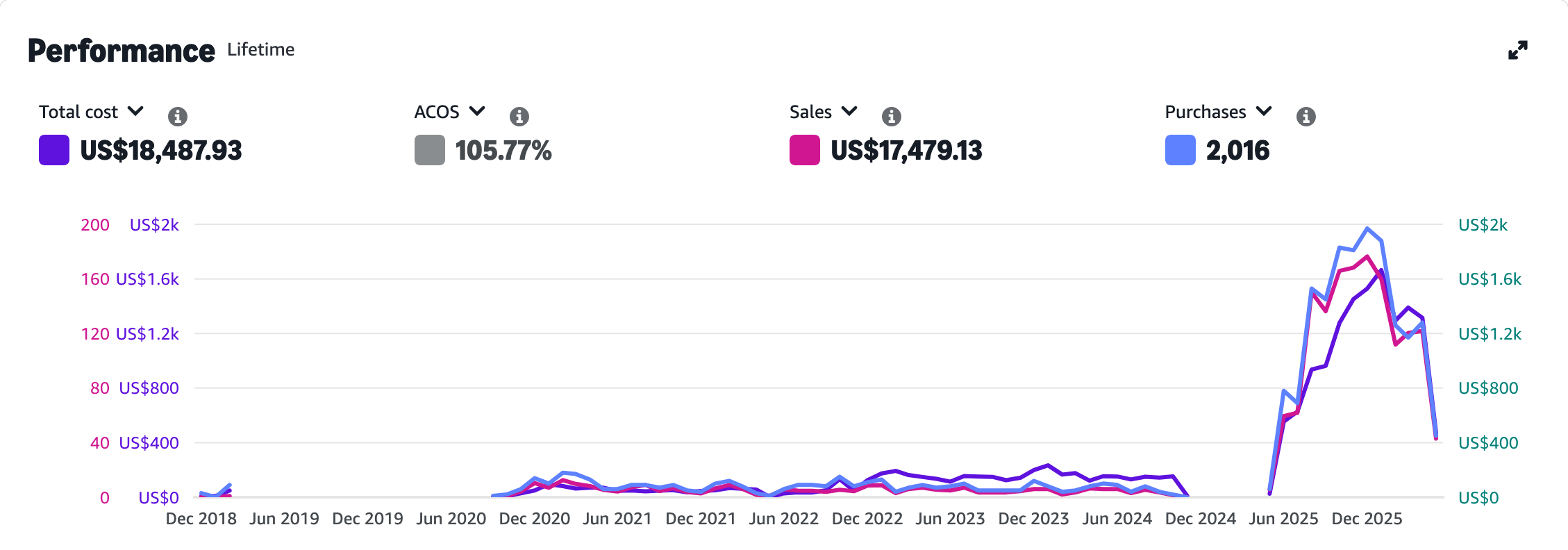
The majority of those ads have been for my two “10 Commandments of SOMETHING” books. Here are 3 lessons learned after 7 years, thousands of copies sold, and $18k+ in ad spend:
1. Use Amazon’s targeting
In 2020, after publishing my first 10 Commandments book, about A-list copywriters, I started running ads to promote that book. I tried ads based on keywords (eg. “stages of market sophistication”). I tried ads based on related book titles (eg. “Breakthrough Advertising”). I tried ads matching the names of people who are somehow connected to my book (eg. “Eugene Schwartz”).
I did the same for my 10 Commandments of Con Men etc. book. I ran various kinds of ads, with various kinds of custom targeting, including search terms for related books as well as all the people mentioned in the book (eg. Robert Cialdini) and some not mentioned in the book (eg. Joe Girard).
This custom targeting worked great. For months after the publication, I was reliably selling 15-20 copies of the book per day at break even or better.
And then in September 2025, everything flipped upside down. Suddenly, my campaign ad spend was no longer being spent, or even close to it. Ad cost per sale went way up. Most importantly, fewer books started being sold, just 5-10 per day, both via ads and organically.
I went looking for an answer. It turned out Amazon had changed its ad algorithm. They started favoring “auto” ad campaigns (which I only had a small discovery budget for) and punishing “exact” campaigns (which was the bulk of my ad spend, because it got better results for cheaper). In other words, Amazon now gave heavy preference to their automated targeting, and made it unprofitable to control your targeting directly.
That’s too bad. Not only was handling my own targeting getting me book buyers for cheaper, but it was fun, and it made me feel like a real direct marketer.
Oh well. No sense in beating my head against a wall. I’ve since learned to love Amazon’s automatic ad targeting because it just takes my money and gives me some book sales in return, without asking for any more of my time and attention. Even so, there is one remaning bit of ad configuration that still makes sense to monitor and tweak…
2. Don’t use Amazon’s suggested bids
When you set up your Amazon ad campaign, Amazon helpfully gives you a “Suggested Bid.” For example, the one for my new 10 Commandments book is $0.79. The one for my old 10 Commandments book is $0.40.
Based on my experience and the reading I’ve done online about Amazon ads, these helpful “Suggested Bids” are calculated to make you spend the most money. That’s good for Amazon, but it doesn’t have to be good for you. Spending the most money on ads can be unrelated to helping you sell more copies of your book, and might even hurt.
Based on recommendations I found online among other book authors, I started by setting my default bids to a fraction of Amazon’s “Suggested Bid,” such as 30% or 50%.
If I was happy with the results — mainly the number of books I was selling — I kept the bid the same. If I wasn’t happy with the result, I slowly inched my default bid up. And if increasing the bids didn’t increase my book sales (or even lowered them), then I decreased the bid to the earlier level.
As of today, the default bid for my new 10 Commandments book was $0.59, or about 74% of Amazon’s “Suggested Bid.” The default bid for my old 10 Commandments book was $0.24, or 60% of the Amazon Suggested Bid.
Is that good? Is that bad? How high of a bid is smart, and how much is it reasonable to spend on Amazon ads? Here’s my take on it:
3. Just try to break even on all royalties, and even that is negotiable
In December of 2025, I was forced into a bit of an experiment. My debit card expired, and until the new one arrived, my Amazon ads were shut off.
Of course, copies of my book that sold via ads dropped. But so did organic sales of my book.
Maybe Amazon was punishing me for no longer running ads by throttling even organic sales of my book.
But I rather think it’s the opposite. My theory is that, if you pay Amazon to advertise your book, and particularly if you make a few sales via advertising, Amazon goes above and beyond in promoting your book to readers organically.
My current ad spend philosophy on Amazon is that I just want to break even across all sales. In other words, the money I spend on ads should be roughly equivalent to the royalties I make on both paid AND organic book sales.
If at the end of the month, I find that I’ve actually made money on royalties when I subtract ad costs, then I’ll increase my ad spend for the coming month. I’ll keep doing so, month after month, until I’m only breaking even, and not making any kind of a profit.
The goal of all my books on Amazon is to 1) build my status and 2) to get people onto my email list. I don’t hope to make money with book royalties at all. In fact, I’m even happy to lose money on occasion (as you can see in the screenshot on top), because I know from past experience that book buyers who join my email list will buy other things from me. A single purchase of a $1k course or a $30k coaching program can pay for a lot of ads.
In the future, I plan to CONSISTENTLY pay Amazon more in ads than the royalties I make. I will do that once I have a funnel for people who sign up to my email list via my book. I’ll make folks an offer immediately (most likely, the recording of the “Manna for Marketers” workshop that I’m creating as part of this Tour de Commandments event).
Whatever money I make from those sales will also go towards Amazon ads. I figure even one or two sales of that a month could be a big deal for helping me sell way more books.